Is it wrong to reach for the stars?
Aurora (2015), Kim Stanley Robinson, and Gypsy (2015), Carter Scholz
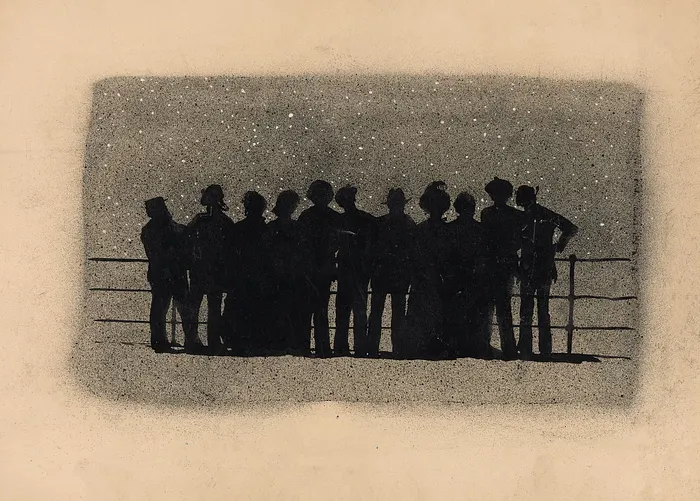
Aurora (2015) and Gypsy (2015) - a novel and novella respectively - deserve to be looked at together because of how closely they’re related. They’re both about failed interstellar missions, both play against expansionist tropes, both were published in 2015, and the authors are personal friends that go hiking in the Sierras together. Gypsy’s author receives special acknowledgements at the end of Aurora. So to say that Aurora and Gypsy influenced one another is an understatement.
But one of these has two orders of magnitude fewer ratings on Goodreads than the other. One I liked quite a bit more, and the other one was nominated for a Hugo. Guess which is which?
Before we go further, there are going to be spoilers for both of these below.
Aurora is a novel by Kim Stanley Robinson, who you probably know for the Mars trilogy, that book about the United Nations solving climate change, or his PhD thesis which is actually a great critical introduction to Philip K. Dick.
It follows a generation ship launched for Tau Ceti in the 2400s aiming to colonise an earth-like planet named Aurora. The book opens 160 years into the voyage as the ship is beginning its deceleration; the ship’s AI is asked to keep a narrative record of the trip, and decides to do this by recording the life story of Freya, the daughter of the ship’s unofficial leader. The first section of Aurora explores the ecosystems of the ship through Freya’s wanderjahr, before the plot begins in earnest with the arrival at Tau Ceti. Aurora is habitable, but it is infested with alien prions that infect and kill the landing party. The ship’s population splits, with some choosing to stay and attempt to terraform another planet, and some refuelling the ship to head for Earth. Freya elects to return; on the way back, the ship’s ecosystem starts breaking down, and the crew only survives thanks to cryosleep pods recently invented on Earth. The laser array they require for braking at Sol is long decommissioned. Many on Earth are resentful of the ship’s return, and it only receives braking at the last minute. It’s barely enough to allow the ship to perform a series of extreme gravity assists over twelve years, culminating in its destruction after dropping off the survivors during a flyby of Earth. Freya adapts to her new life on Earth, confronting factions with various attitudes toward the returned crew, and eventually coming to terms with her new life.
There’s a lot of good stuff in Aurora. The examination of the society within the generation ship is great; there’s good treatment of under-explored issues in this context like governance and chafing against hard constraints. The particular highlight is KSR bringing his ecology and planetology expertise to bear on the island ecosystem of a ship like this. Aurora and the ship are wonderfully sketched. The braking sequence is beautiful and serves to illustrate just how precise interstellar maneuvers are (never mind that it’s impossible as depicted). On a literary level KSR is, as usual, a cut above the median SF novel.
But we should really compare this to other KSR books. The prose is pretty good, occasionally great; but he’s done better elsewhere, like the Mars books and The Years of Rice and Salt. The characters aren’t bad and have some good moments, but I don’t think character work has ever been KSR’s strong suit - he’s better at writing about systems from 10,000 feet. The trouble with Aurora is that it’s a good novel married to a polemic, and this distorts the characters for the sake of KSR’s argument. They’re forced into roles or constrained in how complicated they can be.
The ship’s AI is one of the central characters, but I found it one of the weakest elements of the novel. It’s the silicon equivalent of Star Trek’s green humanoids, burdened with the cliche of analytic, almost autistic thought. This is already obsolete just a decade later, and compared to LLMs it’s simultaneously too human and not human enough. Its ruminations on human language also haven’t held up in the face of actual LLM research. It’s not all bad, but the best of it doesn’t always land. KSR is unusual among SF writers in that he tends to do worse the closer he gets to the inside of a computer; the fact this book needs an AI to make the plot work ends up weakening it. At the same time, I think the narrative structure the AI enables is one of Aurora’s best features.
Like other KSR novels it gets bogged down at the finish line, this time with a digression into surfing and artificial beaches. I think this dilutes rather than amplifies previous good material about the ship’s crew reuniting with Earth. All the other KSR hallmarks are there, too: the book pivots on a hiking scene inside the ship.
But this is SF, I hear you say, what about the fundamental ideas and arguments? Well.
You know how I said that Aurora is a polemic married to a good novel? There’s another dichotomy which is a bit more subtle here. Aurora, on the surface level, has a lot of science. Especially in the early sections there’s pages and pages of jargon about greedy algorithms this phosphate that as KSR sets up all the conceptual scaffolding for the ship’s ecosystem and the narrative structure. This is a book that scans as ‘sciency’ and ‘rigorous’. The trouble is that some of this is genuine rigor, mainly the ecology and planetology, and some of it isn’t. The AI stuff is easier to spot - this is just KSR playing around with concepts to try and do something interesting from a literary perspective, fair play - but the actual interstellar trip has this veneer of rigor without anything to back it up. I think this is because that part doesn’t really matter. Aurora is not trying to be an empirical argument about the impossibility of interstellar travel; it’s a literary reaction against a set of tropes and narratives about expansionism that KSR dislikes on philosophical/political grounds. The trouble, in my opinion, is that the book wants to have its cake and eat it too. If you’re not paying careful attention you can come away thinking you’ve just read a realistic account of what an interstellar mission might actually look like.
There’s a segment where KSR makes fun of the Drake equation, which I thought was ironic. Aurora’s interstellar mission boils down to a kind of Drake equation: a scenario where KSR has set up a bunch of arbitrary parameters and then formed a conclusion from the output.
We can get the most petty objection out of the way first. The propulsion system of the ship and its maneuvers seem realistic but fall apart in the details. But, sure, lasers, fusion pulse drives, Oberth maneuvers, these are all good ideas.
I think the part that makes the Aurora mission most contrived is the technological selectivity. What I mean by this is that the mission is launched centuries into the future, and traditional engineering has advanced commensurately (e.g. that fusion pulse drive), but there’s essentially zero biotech advancements. KSR wants to send baseline humans, so he does, but this seems unlikely to me. Genetic engineering is hard but seems easier than interstellar travel. At the very least greater longevity would solve a lot of the crew’s problems with passing on expertise and genetic degeneration.
Well, there is one major advance we see, which brings me to my third point. The mission planning is stupid, which I think is KSR making a point about rah-rah attitudes to colonisation. Earth sends one probe and then a generation ship with thousands of settlers immediately. There’s no supplies or robotics sent ahead (they have self-replicating nanotech printers, by the way), which would make everything much easier and is already common sense for Mars missions. And the biotech advance is the cryosleep pods, which render many of the generation-ship problems moot. However, the pods need to exist so we can have one protagonist live to see both Tau Ceti and Earth.
The catch-22 at the heart of Aurora’s pessimism also deserves attention. Basically, in their world interstellar colonies are impossible because you either go to a wet world which is living and poisonous, or a dry world which is frozen and can’t be terraformed before your ship’s island ecosystem crashes. It’s a neat picture but both halves of the problem are treated as very hard constraints in the novel (one character literally thinks it’s the solution to the Fermi paradox) and I don’t think they are. Terraforming is a soluble problem because it’s optional, you can adapt yourself and meet your environment in the middle, but we already covered the biotech angle. That’s off the table, so let’s leave it. Then there’s the prion problem. The bailey here is obviously absurd. In real life, the target planet is not going to have nothing but prions which can also reproduce in humans. But the motte, that native biospheres on habitable worlds might be hard to deal with, is a real position. It’s just a speculative one like the Dark Forest. We have close to zero evidence here, so everything is speculation until we can get some realllly big space telescopes running (or something).
So Aurora is really KSR’s humanistic argument against expansionism for its own sake. I am sympathetic to some of this but in general it didn’t land for me. The main problem is that KSR chooses to go after easy targets. I wouldn’t call the ‘space cadets’ in Aurora strawmen, but they aren’t representative of the strong version of this argument. For that you can refer to, say, Terra Ignota. Instead these are space chuds.
We get cardboard caricatures literally standing around smirking and twirling their mustaches at our protagonists. We get wise old men and women shaking their heads ruefully at the sheer foolishness of these antagonists. We get the narration finger-wagging at us. We get our lovable protagonist (who has never done anything wrong, ever, in her life) punching out the avatar of these insufferable types, live on stage. Then everyone reassures her she was in the right. Take that!! To be fair, Freya’s punchout is justified in this situation, but it feels like Gigachad’s justified disdain for the snivelling wojak.
KSR fails his intellectual turing test on his opponents. The drive to expand beyond Sol is presented as straightforward narcissism, imperial expansion - a base instinct compared to the wisdom of appreciating Earth. But Aurora’s world is a dead end. People have completed industrial development, but now there’s nothing left to do - KSR is right that Earth becomes listless but the interstellar gulf is too wide for baseline humans. And this is the real argument for the stars. They will challenge us and so they will change us. That’s the point.
Aurora makes the point that only the first generation on the ship is able to consent, and their descendants are confined to a fascistic prison society. This is well-executed and a good point, but I think Aurora also overplays its hand here because even people on Earth are unable to consent to the usual difficulties of existence. Upon returning, Freya reflects that many people stuck on a stagnant Earth have nothing better to do all day than whine, in contrast to the colonists left behind at Tau Ceti who, while probably doomed, at least don’t lack for diversions. And aren’t we all doomed regardless?
Tau Ceti is wonderfully sketched but it doesn’t feel as though there is any value in coming all this way and laying eyes upon a foreign sun even though the mission cannot succeed. Instead there’s just pragmatism and resentment of those left behind on Earth centuries ago. In some ways this attitude comes across as more narcissistic than the expansionism KSR is attacking.
Aurora is still worth it for the island ecosystem material, but I think most people should read A City on Mars instead. If you want to be a space skeptic, it’s a much more solid foundation.
Much like its interstellar starship, Aurora tries to reach too far and do too much; Gypsy keeps itself narrow and grounded, and is much better for it.
You probably know who Kim Stanley Robinson is, but who’s Carter Scholz? I think more people should read him. He hasn’t published much, a few story collections and a couple of novels, but his best is very, very good. Like KSR he lives in Berkley, was born in the 1950s, and spends a lot of time hiking in the Sierras. But his interests are more diffuse (he’s also an accomplished jazz musician) and he’s never been interested in or suited to the mainstream success KSR has achieved.
Gypsy’s interstellar mission is much smaller in scale. Its world is the near future, the 2040s, and best described with a collection of buzzwords which will allow you to fill in the blanks: sea level rise, overpopulation, surveillance state, imperialism, late stage capitalism, refugee, student loan, forever war, and the aforementioned military industrial complex. The premise is that a physicist who pioneered fusion for clean power only to watch it be repurposed as a weapon becomes disillusioned and decides to build an interstellar starship in secret. The Gypsy, as the ship is called, is an amalgam of parts stolen from the wealthy and the US military. For instance, the crew quarters are a billionaire’s orbital bunker and fusion warheads are used for propulsion. There are twenty crew, all hand-picked to fill a specialist role. The plan is to spend the ~century-long trip to Alpha Centauri in suspended animation, with crew members woken only to deal with critical system failures, then land on a hopefully habitable planet with a few months of supplies. If they can’t become self-sufficient by then, it’s over.
You might say this plan sounds like a long shot. That’s the point. From the beginning there is essentially zero hope that this mission will succeed, and the narrative is a chronicle of decay as the crew is woken one by one to solve increasingly intractable problems.
The essence of Gypsy is the mean time between failures. Scholz models civilization as a complex system which will eventually accumulate errors and fail entirely; this is a familiar perspective to anyone who has read Vernor Vinge’s A Deepness in the Sky. Vinge’s Qeng Ho are an interstellar trading culture who spend most of their time in transit between stars. Because of relativistic effects, a single Qeng Ho can live to see the rise and fall of planet-bound civilizations, and they think about the cultures they visit in a similar way: a cycle as the system accumulates complexity and collapses. I think this lends legitimacy to Scholz’s socialist viewpoint, as you can hardly accuse Vinge of being a socialist. Anyway, this is Scholz’s Fermi solution - that the MTBF of civilizations is too short for them to expand beyond their solar system. This seems much more reasonable to me, a problem more existential than KSR’s concerns about alien biology. Scholz is simply more politically pessimistic, even nihilistic than KSR, and that means Gypsy is much more cohesive, though I disagree with large parts of Scholz’s worldview.
At one point the mission’s ringleader says, in response to the idea that his plan is impossible, that it’s “less impossible than here”.
So one thing Gypsy is really good at is making you feel the difficulty of interstellar travel. Scholz is not usually a hard SF sort of guy, but unlike Aurora there is real, intense rigor behind the voyage of the Gypsy. Unlike most interstellar ships it uses technology that mostly exists rather than hand-waving important problems with speculative solutions. It’s also allowed - even expected - to fail. KSR tells you about the miraculous capabilities of his ship while also telling you how terrible it is. Scholz shows you that the Gypsy is a marvel of engineering, maybe the greatest technical achievement of mankind, but also shows you how that falls short. The Gypsy does well. Things mostly work, untested systems succeed, and the ship almost makes it. But in space, almost isn’t good enough.
There are a few major challenges with interstellar trips, all of which Gypsy covers masterfully. First, your speed is so great that even tiny particles impact with enormous energy. You can shield against this, but the shield has to be perfect, or the ship will be damaged. The trip will take a huge amount of time - probably at least dozens of years - from your point of view. Things are going to go wrong on the ship itself, which will need to be able to self-repair. Imagine your laptop running for eighty years! We have very little technology which can survive for so long in the harsh environment of deep space.
And you’ll need to survive the trip, too. One of Gypsy’s best features is its use of hibernation technology. This is the same cryosleep concept that Aurora uses to get its characters home, based on research on inducing bear-like hibernation states in humans, but Gypsy looks at it in more detail. Gypsy’s crew uses a suite of drugs and medical technologies to enter this deep hibernative state, cooling themselves to just above freezing and slowing their metabolism to a crawl. The experience of each crew member waking from this state at the start of each chapter is visceral. Scholz captures the revolting details of what this would do to a normal human body. Regardless of who the characters were before the voyage, by the time we meet them they’re all exhausted starvelings that smell like preserved corpses. There’s another aspect to this I haven’t seen before: the anti-senescent drugs they use don’t work perfectly, so by the time our protagonist awakes for the arrival at Alpha C she finds herself an old woman. The horror of waking to find your whole life gone, wasted in unconsciousness on a hibernation slab, is really something. And she’s all that’s left: the rest of the crew is dead at this point. The hibernation tech worked well but not perfectly, and fungus managed to grow in the ambient conditions of some crew’s bodies. This is still, all things considered, a pretty good result for a first trial of the technology.
The mass margins here are very tight. The ship also accumulates some damage and many malfunctions during the journey, despite crew corrections. So by the time the Gypsy makes it to Alpha C there simply isn’t enough fuel to slow down: just enough to swing around one of the suns and make a flyby of the target planet. Sophie, the first and last character to be revived, can only watch as the ship sails past a world with liquid water and off into interstellar space. The Gypsy passes closer to its target than the distance from Earth to the Moon. So close… and yet.
Scholz’s characters are much better than KSR’s - more complex, more flawed, highly skilled but still human. Obviously they have no life onboard the ship, just pain to endure and faults to diagnose, so we learn about them through fragmented recollections of their lives on Earth. The backstory of the mission comes together as the ship comes apart. Of course their lives match the tone - brief wins immersed in injustice, failure, abuse, and so on - but they’re fun to spend time with. Gypsy’s narrative focus is claustrophobic and this helps bring out the characters, whereas Aurora’s protagonist never feels like more than a component of a larger system.
Sophie is the closest thing Gypsy has to a protagonist. There’s that line from Contact - “they should have sent a poet”. Well, in Gypsy, they do; Sophie trained as one before a career as a technical librarian for a defence contractor, which qualifies her for the interstellar trip. But it’s really her poetic chops that matter in the end. Even though the fate of Gypsy’s mission is much bleaker than in Aurora, Scholz captures the sublimity of interstellar travel in a way KSR doesn’t. The voyage of the Gypsy feels at least bittersweet and almost justified for the scraps of Sophie’s verse we’re left with. In this sense I feel Aurora is actually more pessimistic. Its characters survive, but it was never worth going in the first place.
I’m left with mixed feelings about both of these works. I was pretty hard on Aurora here, but I did have a great time with it as a novel, and I appreciate what KSR was trying to do. It’s good to have intelligent, lively debate going on around these issues; thinking about Aurora has helped me clarify some of my own positions, even if I don’t think it achieves its objectives. As for Gypsy, for all my praise of it as a literary work and a hard-SF Faberge egg, I strongly disagree with Scholz. I think his political program is stupid. I think his nihilism only works with intellectual blinkers applied. And I think he’s simply wrong about many object-level facts (Gypsy has oil reserves running out in 2020).
This all leads into the question of how much any of this debate matters. I feel that it does: these are important questions. But interstellar travel is such a difficult problem, and so far beyond our present selves in every respect, that speculation could be a waste of time. I’m reminded of all the premodern treatises on flight debating back and forth about the best way for a man to strap wings to his arms and flap them.
In that case, the skeptics were right; and then they were wrong.