Notes on Curiosity
The Design and Engineering of Curiosity (2018), Emily Lakdawalla
Is a cathedral beautiful or tragic?
There was no tragedy for the people who made them, but today the old pinnacles of human achievement have a new angle. You can't help but look at them and think of the human lives spent quarrying, driving, and setting stone block by block. Hardly the greatest tragedy of premodernity, and even today there are plenty of worse ways to spend a life, but undeniably a tragedy.
We don’t drag blocks of stone around anymore, but we still build cathedrals. From 2004 to 2012 they made one called Curiosity, put it on a rocket, and shot it at Mars. To describe the medieval cathedral is to describe the world that made it. Its geology, its politics, its weather, and above all else the straitjacket of energy that circumscribed its dreams. So what does Curiosity say about us?
First we want to know why we built this cathedral at all. Curiosity's objective is to "explore and quantitatively assess a potential habitat on Mars". That is, to look closely at pieces of Mars to figure out if something had, or could ever have, lived there. We already had a decent idea of the chemistry and mineral composition of surface rocks from past rovers, but Curiosity would need to go deeper, drilling below the surface and digging into the details of minerals and any organic compounds found in the environment. The overriding objective, in other words, was to sift through the ashes of a dead world to search for the most minute sign that we were not always alone amongst the darkness. And even, maybe, something more: a machine made by children of bacteria scattered to Earth on asteroids, returning home at last.
You could get the previous paragraph from pretty much any source on Curiosity. What I really like about Lakdawalla's book is that it strikes a balance. She assumes you are not going to get bored by her explaining the different sample handling pathways, writes a clear and engaging narrative, and most importantly is writing for an audience outside of JPL's cloisters. It lets you actually get into the details.
Right. Say we are a rock, full of nice juicy organic residues. How does Curiosity find that out?
First it has to see. For this purpose there are three cameras - Mastcam, MAHLI ( “hand lens imager”, on the drill arm), and MARDI (“descent imager”, on the body, now good at taking pictures of, like, the ground).
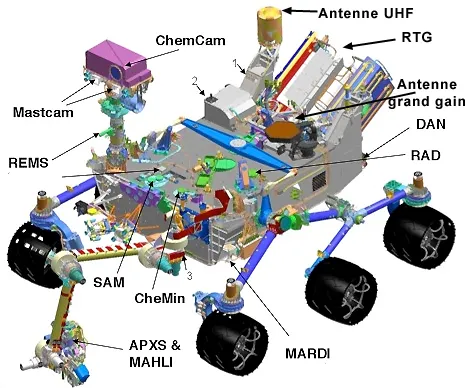
These are pretty good cameras thanks to a little company called Malin Space Science Systems which decided space missions could use HD cameras in the late 80s and kept working despite little initial interest from NASA. So Curiosity can take 720p video and 1600x1200 HD pictures. Right, so we can see the rock, and it seems interesting to the geologists back at JPL. Now we can characterize it. For Opportunity this would mean driving up to the rock and peering at it point-blank, but Curiosity can do basic spectroscopy remotely with LASERS thanks to ChemCam - vaporize some of the rock with the laser, and characterize the plasma with a paired camera.
Now we know what the rock basically looks like we can drive up and scoop/drill/grind some of the material, which is then sieved and portioned into a shot of sieved grain with a little Rube Goldberg machine mounted on the drill arm called CHIMRA1. Now we can dump that aliquot2 into one of the instruments lurking inside Curiosity’s body. This is either CheMin, which does X-ray diffraction to characterize mineralogy, or SAM, the “big cheese” of science instruments sent to Mars in the early 2010s. This is the one that does the organic chemistry - mass spectrometry, fed by a gas chromatrograph to seperate things out, plus atmospheric analysis via laser spectrometry.
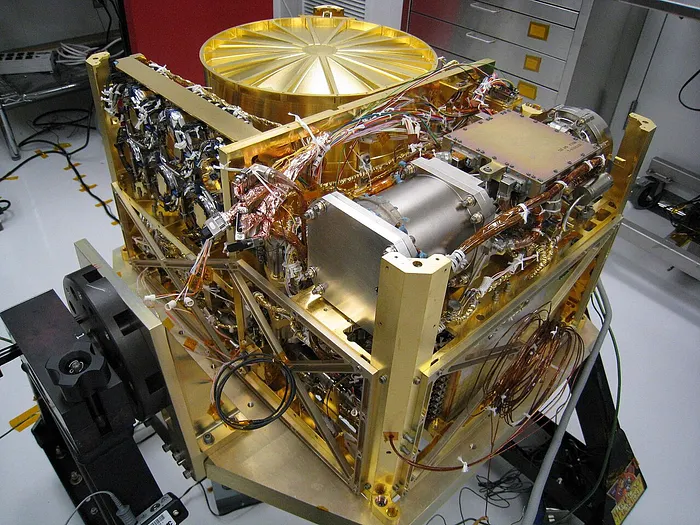
Sounds good! You’ll notice I skimmed over all this stuff, because I’m not about to drop the definitive explanation of Curiosity’s science instruments on you. Go buy Lakdawalla’s book, it’s really good at that. But also, the science instruments weren’t what I found most interesting; they’re basically what you expect3, beautifully engineered one-off miniature laboratories that have performed admirably and produced great data.
But you’ll also notice we skimmed over some other stuff. To do the science part we had to navigate, drive, and talk to Earth; we also needed power, and to get rid of our waste heat. Oh yeah - how did we get to Mars in the first place4? If SAM & co. are the soaring buttresses and stained glass windows of Curiosity, these parts are the guys sweating away in the quarry.
Reading these parts of Lakdawalla makes you realize that Curiosity barely works.
This is not some sort of own directed at 2000s JPL. If anything I am in awe of these people. They had an environment and a problem, and they came up with basically the optimal solution under their constraints. What does that look like?
Mass
On the launchpad, Curiosity was approximately (by mass) 91% fuel, 8.2% launcher structure, 0.1% interplanetary cruise equipment, 0.5% Mars landing equipment, and 0.2% rover. You can imagine that JPL spent a bit of time trying to make Curiosity lighter.
A great case study for the effects this had were the wheels. Previous Mars rovers had landed using giant airbags and parachutes, but this wasn’t going to cut it for Curiosity - the rover would be so large the airbag setup would simply be too massive. A controlled landing also offered the advantage of narrowing the possible landing zone a lot, allowing JPL to target particular interesting geological features.
Hence the sky crane, but of course there wasn’t the mass budget for separate landing gear on the rover. So the wheels and suspension need to also serve as landing gear. These are the same wheels that are made of 0.75mm5 thick machined aluminum (not the primary load path, however, they have grousers) because mass.
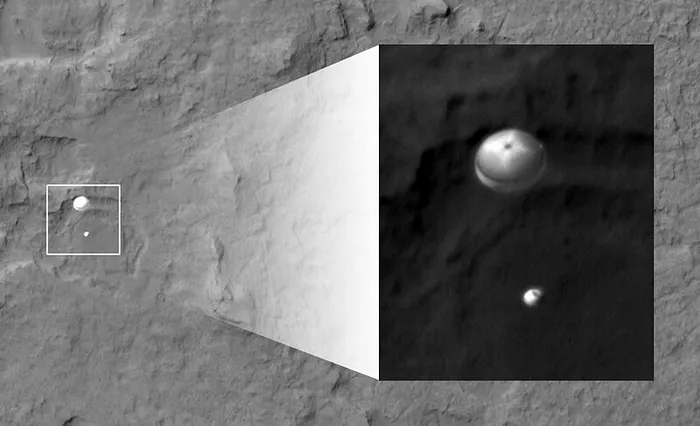
This almost ended the mission on day one: the sky crane maneuver took 17 seconds instead of the nominal 15. JPL's modelling of the landing had used a value of gravity that hadn't accounted for the tenth-of-a-percent variation introduced by the shape of the local terrain6. So it came down to two seconds. Thankfully it was in the right direction. A fast landing could have destroyed the mobility system.

Energy
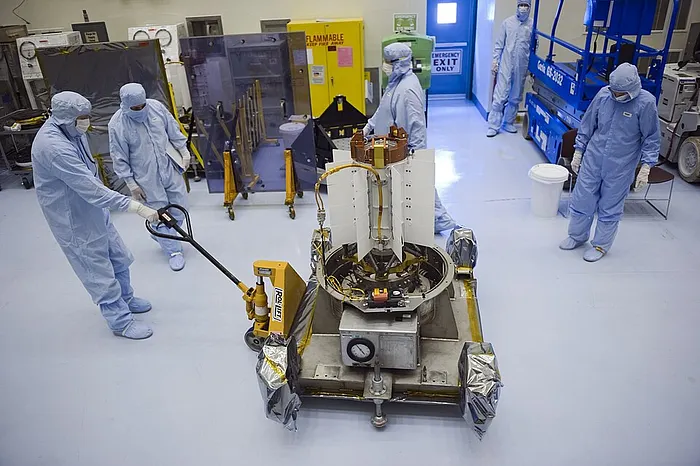
Powering Curiosity is the MMRTG, a plutonium brick that generates about 2kW of heat, with thermocouples that manage about 5% of that as electrical power7. I love these things. They're the powerplant equivalent of those engines you see on soft sci-fi ships: a hot rock with no moving parts that makes continuous electricity for 20 years. And we really want something with no moving parts in the "average PT Cruiser owner" service environment Curiosity finds itself in8.
Of course there’s the other option for inanimate objects that generate electricity, namely solar panels, but:
These were much worse in 2007
They get covered in dust
They fail before RTGs
Mars gets 1/3 the insolation of Earth
So the RTG is the best we can do and in fact is a big upgrade from the previous solar-powered rovers. 110 watts from a 40kg powerplant9 is as good as it gets for specific power. We could get more power, but this means introducing moving parts and probably blowing out the budget while we’re at it, or making tradeoffs to fit a larger RTG with larger radiators. And, practically, that larger RTG doesn’t exist (MM stands for Multi-Mission); there goes the budget again.
Hey, uh, isn’t 110W pretty low for something the size of my car?
Yes, which is why Curiosity only spends a few hours of the day awake, and runs off 84Ah of lithium-ion, another component which was much worse in 2007. And before those operational hours start you need to spend another couple of hours using waste heat to warm up many of the components, which can’t operate in Martian ambient conditions10 . Also, the top speed is 4.2 centimeters per second, slow enough that the motion of the motors is quasi-static11.
Communications
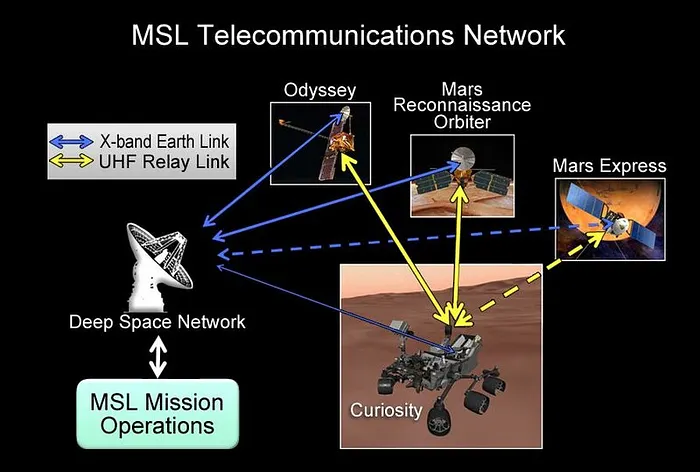
To start with there’s the delay of 4-24 minutes for signals to get from Earth to Mars or vice versa thanks to lightspeed. But all of Curiosity’s data needs to get back to Earth somehow, and there’s one option for that - the DSN. Curiosity does not have the onboard equipment to send powerful X-band12 transmissions straight back to Earth at reasonable bandwidths. So it has to use its UHF antenna to talk to one of the three orbiters13 to get more data through.
But there isn’t always an orbiter overhead; once you wait for one to show up, you can start downlinking experiment data… typically around 60mb per sol14. Files can wait weeks for their turn in the queue. The constraints aren’t just technical. Time on the DSN is strictly rationed by a nightmarish web of processes, because all deep space missions have to rely on its three sites.
Compute
Then there's the onboard computers - two redundant15 RAD750s. Space enthusiasts are quite familiar with these things: over 150 have been launched since 2005. The James Webb telescope runs off one. BAE, who makes them, describes them as "the most powerful radiation-hardened general-purpose microprocessor ever developed"16. In Curiosity's case this means 133MHz, 256mb of RAM, and 4GB of flash storage17. Of course, a larger computer would immediately run into the power and thermal constraints. It's also worth noting that those 4GB aren't the only storage available, since each instrument has its own flash drive for backing up all the data that can't fit into the uplink.
In today's world of web apps that eat gigabytes of RAM this is nothing short of astounding. Sure, the Apollo landers ran off a computer smaller than your graphing calculator, but Curiosity is no match for a raspberry pi, and it didn't have ~150 petaflops of human compute flying it.
Operations
How do we deal with all of this? With insane levels of operational complexity, of course. The first thing Lakdawalla impresses upon you is the sheer amount of human capital dedicated to Curiosity's operations. Every one of its components is monitored. Every movement of its motors is planned days in advance. There's a whole calendar, complex enough to put a Catholic monastery to shame, based around solar conjunctions and Martian seasons and fitting an extra forty minutes in the day (Martian days, or 'sols', are 24 hours and 39 minutes). Here's a few glimpses to solidify things for you18:
There are four levels in the planning hierarchy: Tactical, Supratactical, Strategic, and the Project Science Group, which acts like a kind of board of directors with representatives of each science instrument.
Heating components to prepare for ops everyday involves hour-by-hour tables of worst-case heating requirements that are applied based on the current Martian season.
This quote gives a good idea of the sort of operational headaches that orbital mechanics introduces:
After sol 90, the science team members returned to their home institutions and the mission transitioned to Earth time. They had increased planning efficiency to the point that one sol's worth of activities could be developed in a 9-hour planning day. Earth time operations are permitted to take place between the hours of approximately 6:00 a.m. to 10:00 p.m. California time. So in a day where uplink needed to take place no later than 4 p.m. California time, they could begin the planning day at 7 a.m., an "early slide sol." In this way the team could operate as though they were on Mars time for about half of the sols, as long as they could fit a 9-hour planning period in work-permissible hours within the 16-hour window between the receipt of end-of-sol data from Mars and the time of the next sol's uplink.19
Planning is constrained by, among other things:
"Restricted sols" when crucial data arrives from Mars in the middle of the Earth day and planning for the next day has to begin without knowing if previous commands succeeded
Solar conjunctions, when the Sun is between Earth and Mars, which make communication unreliable for weeks at a time - luckily these only happen every couple of years.
Weekends and US public holidays
Political decisions about the budget of the Deep Space Network
On top of all of this you have anomalies and things going wrong, which have to be worked out while everything else is going on, and often introduce their own little complications to the operational profile like a Swiss watchmaker trying to outdo himself.
Remember those wheels? If you’ve followed the Curiosity mission, you probably remember all that wheel damage they had to deal with. About a year into the mission JPL noticed some significant punctures and tears in the forward wheels, which rapidly got worse. The wheels were being driven into protrusions that were sharper than expected20. So the fix was to be much more careful in route planning and driving, which meant that the automatic navigation system couldn’t be used anymore, since its 20cm resolution was too broad to resolve the sorts of features that could cause wheel damage21. Why was the resolution so bad? Because there wasn’t enough onboard compute.
And because of the mass constraints Curiosity is insanely complex; in many ways it feels like the closest we’ve come to building a biological organism. It has organs, it’s constrained by energy, it’s adapted to its environment… Mostly, though, its unique constraints have forced us to build these clockwork organs packed into a tiny body rather than spreading the complexity out over an entire building. And so JPL’s Curiosity ops are sort of like a command economy for a living organism.
Constraints
We can look at Curiosity the same way we look back at medieval cathedrals and see its extreme constraints clearly; it’s easy to imagine lifting these with the resources we have now, if only we could reach back in time or across the void, and do so much more. But on Earth today what is not seen remains invisible. I shouldn’t have to draw the parallel for you: we are still so constrained by our energy, our compute, our insitituitions - both the kludges they must have to work in our current environment, and the cruft that has built up, the price for decades of stability.
Meanwhile spaceflight itself is in an odd place. On the one hand you have Curiosity and Perseverance, the pinnacle of Old Space, designed and delivered after the end of history. But at the same time, weeks before this post, SpaceX celebrated the 500th launch and landing of an orbital booster. There’s a revolution just starting to blush over the horizon, one that may sweep away many of the privations Curiosity had to labor under. SpaceX has the courage to see those constraints and attack them directly. The 20th century had many errors too enourmous to describe in words, but they got that so right it almost doesn’t matter. In so many walks of life we’re reduced, again, to building cathedrals, waiting for that spirit to come around again.
But even should SpaceX’s future come to pass, Curiosity will remain quite beautiful. There's a purity to everything JPL builds, even though it is ruthlessly practical; I owe Bezos for the observation that "when you go for that last 1% of function, it really makes things beautiful." There’s great beauty in things brutalized into a particular shape by extreme constraints. But there’s beauty, too, in the other direction: the perfect system, which can buy simplicity with its excess of resources. Spherical, mirrored omnitools beckon from the distant mountains.
Functionality in different domains also breeds different degrees of beauty. Curiosity is not beautiful in the way of a Macbook, an F-35, or an F1 car. To me space hardware has a special innocence. These machines don't need the aggression of an F1 car. They're not competing for anything, and they have nothing to prove. An F-35 isn't aggressive either, but it's grimly clinical in a way the rovers aren't. Finally there's not a trace of the Macbook's commercialism.
Rather, mass constraints and low gravity make space hardware willowy, delicate. They are an ideal to strive towards. Peaceful, energetic and industrious. Passionate. Dedicated to knowledge so that we might better appreciate the wonders of the world. I think no Christian cathedral built in the last several decades can compare.
Godspeed, Curiosity, and may the future make of you a tragedy.

CHIMRA, ahem Collection and Handling for In Situ Martian Rock Analysis, is insanely complex. It’s not even mentioned on Curiosity’s Wikipedia page, but Lakdawalla gives it 15 pages compared to 14 for ChemCam (which has its very own Wiki page). Basically it uses vibration and tilting to sift material through various sieves into little sample pots, guaranteeing standardized samples for Curiosity’s instruments with grains no larger than 1mm or 150 micrometers, depending on the pathway used. Part of the complexity stems from the fact that you really, really don’t want this thing to clog up, so it has all sorts of accoutrements to make sure things sieve properly. These have great names like “vibe actuator” or “secondary thwack actuator”.
↩Something else I learned from this book is that more people should use the word “aliquot”.
↩There’s even some instruments I didn’t mention. Yeah, they put a passive radiation detector on it. Findings: there is radiation on Mars. I’m guessing this is not the sort of penetrating analysis you come to Substack for.
↩I’m not going to go too deep into EDL for this one because, like the science instruments, it’s well-covered elsewhere. Go buy Lakdawalla or just watch Seven Minutes of Terror. But it does impose its own set of straitjacket constraints and depends on another set of near-impossible technical challenges that all have to work one after another. And Curiosity is doing all of this autonomously using its RAD750.
↩If you want to annoy your machinists, mention this the next time they complain about dimensions.
↩Pg. 100, “We were to discover after MSL had landed…”
↩Pg. 144.
↩So many constraints are downstream of the fact that everything is permanent. Get something clogged and that pathway is gone forever. Drive into a rock the wrong way and the mission is over.
↩Pg. 138.
↩Important components like the cameras and motors. The origin of the issues with the latter is a saga all the way back in design involving a switch from dry to wet lubricant.
↩Pg. 164.
↩X-band is the standard for this for a few reasons - among others: good beam width, atmospheric penetration, and a reserved chunk of spectrum.
↩All three of which were launched between 2001 and 2005, so you can imagine the tech level there. Curiosity as well as all of the orbiters are still operating, though two more orbiters arrived during the 2010s.
↩Pg. 154, “Curiosity typically returns 500 megabits per sol.”
↩Good thing they're redundant, too, since the rover has been running on its B computer for most of its life after a flash memory failure in the A chip!
↩Yeah. Any interest in my fastest-ever horse and cart?
↩Pg. 146.
↩All of this info is taken from Chapter 3, Mars Operations.
↩Pg. 116.
↩Lakdawalla mentions that at this stage all six wheels were being driven at the same speed (pg. 176), so there was some dragging going on with the front wheels when climbing. This seems like another side effect of compute limitations, but it seems to have been remedied and replaced with a proper traction control algorithm from 2017 onwards. I’m not clear on the details here.
↩Pg. 232.
↩