Airships - Imagineering
Ships and planets for aeronauts
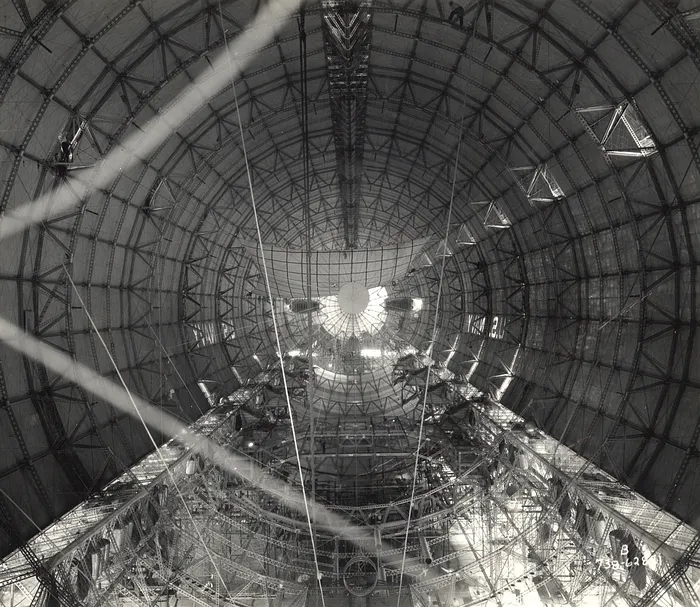

This is the third instalment of a four-part post. We’re covering the third topic, design, this week.
How airships have been used in fiction, with a focus on the fantasy genre.
The design of a fictional airship in detail and how we can modify her world to suit.
How a society and economy dependent on airships works around the ships themselves.
Airship design
First, a disclaimer. This post required a lot of spitballing, Fermi estimates, and low-resolution models. I wouldn’t be surprised if I got something wrong or failed to consider a couple of important things along the way. If you think I did, let me know! Luckily this is all an exercise in fictional engineering, which never killed anyone.
How do they stay up?
In this post we’re covering airships, which I’m using as a term for a free-floating powered aerostat, that is, an aircraft which stays aloft using static lift. This is in contrast with an aerodyne, which stays up using dynamic lift (e.g. it gets lift by traveling through the air, like an airplane).
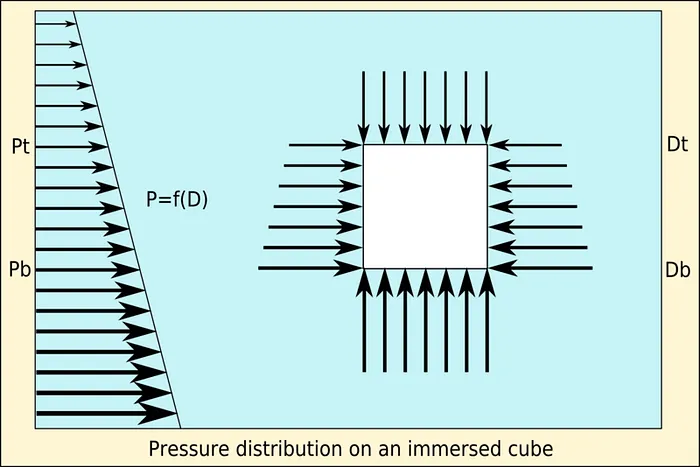
In this case, static lift means buoyancy. Let’s imagine we push a cube of ice into a glass of water. We’re going to feel a force trying to push the cube out. Why?
In the glass, pressure increases with depth. The water at the bottom has to support the weight of water above it.
The water will press against each side of the cube with a perpendicular force due to the water pressure.
The sideways forces are equal and cancel out, but the force from above is lower than the force from below (due to 1.).
The forces on the cube are such that they balance if it’s exactly the same density as the environment around it. If it’s a cube-sized patch of water, its weight exactly counteracts the unbalanced force from below. But since the ice is less dense than the water, the forces are unbalanced, and so the ice is pushed to the top of the glass.
The ice does not rise out of the glass because it’s much denser than air.

So if we build a ship which has an overall density lower than the air at ground level, it will float up into the atmosphere until it reaches a point where it’s the same density as the air around it.
Another key principle we can take away from this is that the amount of lift we get is equivalent to the weight of displaced fluid. So if we have a cubic meter of hydrogen in our balloon, the lift we have to play with is the weight of the cubic meter of displaced air, minus the weight of the hydrogen.
What’s the best lifting gas?
A vacuum. If there’s nothing in the balloon, we get all the weight of the air we displace back as lift. But vacuums are for chumps or wizards: the vacuum is much lower pressure than the air around it, so our ship will be crushed unless it’s very strong. To avoid this we need to build a pressure vessel, which will be too heavy to lift unless we are using materials that are extremely strong for their weight - stronger than the best modern materials.
We want something in the balloon so it can keep its shape, but we want this to be as low-density as possible. Besides changing the pressure there are two ways to change the density of an ideal gas: temperature and composition.
Temperature
We could reduce the density by making the gas in the balloon hotter, i.e. giving the molecules of the gas more energy, so they collide more and push each other further apart. If we double the temperature of a gas in Kelvin, we halve its density. Heating air from 20 to 100 Celsius reduces the density by 21%. Hot air balloons use air around 100 Celsius for their lift.
Using this technique on a serious airship, however, has problems.
We need a bunch of equipment to heat the gas, plus lots of fuel since the heat is constantly bleeding out into the atmosphere. This eats all our lift gains and more. Also, having a fire in an airship is not a good idea.
What if we’re not using fire, and we have some sort of possibly-magical heat source instead? It’s lightweight and a lot less risky than an open flame. But there are still limits. We rapidly run into the limits of even modern materials or begin cooking our payload. Lift gains from heat are marginal no matter how we set things up, and there are diminishing returns. At 120°C our lift is 27% of a vacuum, but to get to 90% of vacuum (still less than room-temperature hydrogen) we need envelope air at 2600°C1. The fact that lifting gases like hydrogen are so light already means we get little out of heating them.
So let’s lay that aside - we want a gas that’s as low density as possible at room temperature and pressure. All that’s left is the weight of the molecules, unless we want to get into non-ideal weirdness like ionized plasmas2.
Notes on fire
Speaking of hot hydrogen, there are a few things to understand when it comes to damaging the gas cells of an airship.
In a rigid airship, small punctures or tears are not a huge deal; the lift gas is nearly at atmospheric pressure, and so will just slowly mix with the atmosphere. Topping up and venting gas is part of normal airship operations.
For a fire to start you need well-mixed oxygen and hydrogen of at least 4% hydrogen. The near-pure hydrogen inside the gasbag is not flammable. Hydrogen coming from a small leak will quickly disperse upwards away from the ship, especially in flight. However, it can become trapped between the gasbag and outer skin, as happened on the Hindenburg.
If you do get the hydrogen burning, the ship is unlikely to explode all at once, but it will burn through its lift gas pretty quickly. The Hindenburg fire consumed all the hydrogen in less than a minute, but of course everything else will keep smouldering for some time.
During WW1, it was often easier for aircraft with machine guns and incendiary ammunition to ignite the fabric of the outer skin than to start the hydrogen burning.
Shooting a hydrogen airship with an infantry rifle seems unlikely to set it on fire. Ignition requires a flame, spark, or spontaneous “autoignition” caused by high temperature. Hydrogen autoignition happens above 500°C (and requires oxygen), which a bullet is not hot enough for, and aluminium or wood frames do not spark readily when hit. However, hydrogen ignition can happen with extremely small sparks like static electricity.
The control of onboard fires or electrical sparks is extremely important, even more so than on traditional ships. This is true for hydrogen and helium airships. Crews in WW1 understood that the airship catching fire was a virtual death sentence for everyone on board.
Composition
Avogadro’s law tells us that containers of different gases with the same volume, temperature and pressure will have the same number of molecules3. This makes things nice and simple: we can just look at the periodic table, which already sorts atoms by how much they weigh, and find the lightest element that is a gas at room temperature and pressure.
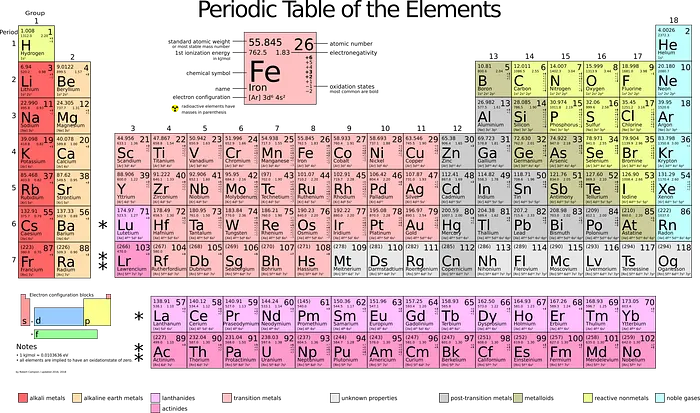

The very lightest elements are gases at room temperature and pressure. Hydrogen is only about 7% of the density of air. This is looking much more promising than our hot air - we can get almost all the way to a vacuum without needing any sort of pressure vessel.
It’s hard to do better than hydrogen
The oldest trick in the book - your fantasy airships are filled with magic gas that’s lighter than hydrogen and stable like helium, plus incredibly abundant.
You can do this. I’m just not crazy about it; I think it’s a much larger handwave than many of the people using it appreciate, and it also doesn’t address the weather, materials, or propulsion questions.
The first problem is that hydrogen and helium are already pretty much magic. Hydrogen is as light as you can go without getting seriously weird - it’s literally one proton, electrons weigh virtually nothing. Either this is going to be some unstable chemical composition, extreme handwave like photo/neutrino/muon/electron “gases”, or a new type of particle. Remember, this is only buying you small amounts of lift relative to hydrogen/helium.
Another issue: if your gas is stable like helium, it’s going to share helium’s problem, which is that nearly all atmospheres are denser than it, so it’s going to escape into space in short order. Hydrogen is abundant on Earth because it likes reacting with things, so we have lots locked up in all sorts of molecules, but helium is a noble gas and so the only source is rare underground pockets. And you’re going to be venting lifting gas during operations, so a whole airship society is going to chew through available supplies fairly quickly.
You can introduce some mechanism explaining why your gas is abundant whereas helium isn’t, but I feel like you might as well just make helium abundant via supernatural means at that point.
Lift crystals
The other classic trick is to have ships in the sky that use a magic lift engine to generate upward forces without a balloon. Often this takes the form of a bound spirit or magical material, like a crystal. You can also do this! Once again, I have my issues with it.
Things often just turn into the age of sail but with clouds, leaving most of the setting’s potential on the table for the sake of being able to port over Master & Commander with as few changes as possible.
The specifics of how this is implemented have massive implications for the rest of society, since these lift crystals probably have more important applications in industry or warfare. I’m not seeing many power plants using a lift crystal hooked up to a square wave generator and a camshaft, guys.
But you’re damned if you do and damned if you don’t. A society warped around your convoluted magic engineering easily makes a bad book, and you have to spend loads of time doing the magic engineering, which usually can be spent more productively unless you’re very committed.
This does have the advantage of making your airships much more compact, which helps with the weather issue, and can allow you lots of mass margin. Often lift crystals will also double as propulsion, but everything I said above applies doubly to these; they’re an industrial revolution in a box.
There’s no replacement for displacement
Ok, let’s zoom out a bit. You may have noticed air does not weigh very much. At sea level, it’s about 1.2kg per cubic meter; a F-150 truck displaces about 13 cubic meters. That air weighs 15.6kg, but the truck weighs 1,800kg. You can see the problem here!
We are fundamentally limited by this: even with a zero-weight lifting gas, we still need to displace the weight of something in air to lift it. Our F-150 needs 1500 cubic meters displaced, for example, assuming a perfect lift gas. Our airship is going to be almost all gas by volume… unless we can make the air around the ship heavier!
Changing the air
Consider a simple case where we double our air’s density by doubling the atmospheric pressure. We need to put more lift gas in the ship to stay at atmospheric pressure, which will make the ship weigh more. But this is practically irrelevant because hydrogen is so light compared to air. You can think of the trade-off as adding more hydrogen to be able to displace more air; doubling the atmospheric density basically doubles our lift.
This was no help for real-life airship operations, but atmospheric density is something that we are in complete control of in fiction land. Still, we should understand the implications of such a broad decision.
Before we can start thinking about implications, we need to decide how we’re actually going to increase density.
Increasing atmospheric density without killing everyone
So what levers do we have to change the density of an atmospheric gas mixture? We can change density by changing the temperature, but think back to our original discussion about hot air balloons: this isn’t very effective. We’d need to freeze the planet to get slightly higher-density air. For a 20 percent increase in sea-level density, we’d need to go from an average temperature of 15°C to… -33°C.
We can also change it by altering the composition of the atmosphere, say by having it composed of heavier molecules but at the same pressure. If we want our characters and world to be recognisable, we need some oxygen in this mix for them to breathe; your initial reaction to this might be that the lighter oxygen would just separate from the heavier gas like water and oil in a glass, but in reality weather keeps the atmosphere mixed and is much more powerful than differences in density. Hydrogen and helium are unusual in that they’re light enough to actually escape the atmosphere, so they slowly leak out over time.
Focusing on keeping our characters alive for now, the main issue is partial pressures. Partial pressures are basically what pressure a gas in a mixture would be at if all the other gases were removed, and these sum to the total pressure for mixtures of ideal gases (which is a fine assumption here). For example, our air is about 21 percent oxygen by volume, and the partial pressure of oxygen in the air is 21 percent of atmospheric pressure.
Human bodies can physically withstand enormous pressures, but breathing is a problem. Because breathing involves driving gases across your lung membranes to capture them, the partial pressure of the gases you’re breathing determine the dosage you get of each gas. Since these gases react and alter your body chemistry, small changes in dosage can be pretty bad. For example, we breathe oxygen because it’s nice and reactive, but this means that high dosages of oxygen will aggressively react with all sorts of things and poison you, for example by driving down the pH of your blood. Even inert noble gases like nitrogen have significant effects at relatively low partial pressures. We don’t fully understand why this happens (if you’ve ever heard that we don’t understand why anaesthetics work, this is the same problem) but we know it has something to do with the partial pressure causing these gases to dissolve into blood and brain tissue.
Anyway, this is all to say that we need to think about these dosages if we want to start messing with the mix of gases in the atmosphere (or increase the pressure, but we’ll get to that later). The gases we could use as a heavy filler fall into two categories: non-noble gases that are horribly toxic and reactive, and noble gases that are rare and powerful narcotics. There isn’t really a non-noble gas that works well as a filler for a breathable atmosphere (the best I can come up with is nitrous oxide which, uh, has obvious problems), so we need to look at noble gases.
At first glance things seem great. Air weighs about 29 g/mol. There are three noble gases significantly heavier than this - xenon at 131 g/mol, krypton at 84 g/mol, and argon at 40 g/mol. And these should behave basically like the nitrogen in our air at reasonable mixtures and pressures, so the only problem is narcotic effects.
But xenon and krypton are very rare in planetary atmospheres. Partly this is because there just isn’t much of them in the universe, because their weight means that they can only be produced by something called neutron capture nucleosynthesis. This only happens in conditions like the interiors of giant stars or neutron star collisions. And they don’t really form minerals; a main source of planetary atmospheres is volatiles outgassed from rocks and ice. There aren’t any geological processes that produce xenon or krypton, so an atmosphere on a recognisable planet of more than a few percent Xe or Kr is very unlikely.
Doesn’t this apply to argon too? Yes, except for the part about a lack of geological processes. Argon is produced naturally by the radioactive decay of potassium-40. This is why our atmosphere is almost 1 percent argon but has basically zero xenon or krypton. So it’s much easier to justify a large argon fraction in our hypothetical atmosphere. The planet would have lots of potassium - not that weird. The changes are variations in plate tectonics and geology rather than “everyone is dead”4.
We could handwave a high xenon or krypton fraction. This is hardly egregious. But now we return to our original problem: narcotics.
Xenon and krypton are both strong narcotics, especially xenon. It’s so strong that we use it as a surgical anaesthetic. Broadly, xenon is extremely powerful, krypton is significantly weaker, argon is significantly weaker again, and then we have nitrogen which is another big step down. Even without increasing atmospheric pressure or considering physical exertion, significant krypton or xenon fractions would probably have noticeable narcotic effects. So this is another point for argon, which wouldn’t be noticeable at rest until multiple atmospheres of partial pressure.
What kind of gains could we actually get from adding a lot of argon? This is a simple matter of working out the average molar mass of the mixture based on the fractions and comparing the result to Earth air. For example, a mixture of 50 percent argon, 29 percent nitrogen and 21 percent oxygen - basically Earth but with a lot of nitrogen replaced by argon - has an average molar mass about 20 percent higher than our air. An extra 20 percent density is pretty good, at least we aren’t freezing the whole planet anymore, but we can do better. And for that there’s only one variable left.
Increasing the atmospheric pressure is the best way to accomplish our goal. As we’ve established, heavier gases all have problems and need a handwave to get anyway. If anything we want to use more nitrogen, because nitrogen is the weakest narcotic of the inert gases. An atmosphere that’s twice the pressure of ours, 90 percent nitrogen and 10 percent oxygen by volume would completely change the game for airships without debilitating people. It would have about the same partial pressure of oxygen as our current atmosphere, and while 1.8 atmospheres of nitrogen is high, most people would not experience any narcotic effects. I think this can be easily ignored for a population that has evolved in the environment; if anyone complains, you can ask what their theory of general anaesthetic action is. If you really don’t care about this you could replace a lot of the nitrogen with a heavier noble gas for even more density.
Where does all this nitrogen come from? The nitrogen in Earth’s atmosphere mostly comes from reserves in the mantle, which outgassed during periods of tectonic activity. Our world could plausibly have formed with larger nitrogen reserves due to lots of ammonia ices or nitrogen-rich chondrites in its initial composition, or have undergone more tectonic activity in the past to release more of its reserves. Or it could have a less extensive biosphere, since a lot of nitrogen in Earth’s atmosphere is fixed into solids by life. This is a natural fit for the classic airship-world setup of a dead surface shrouded in cloud.
So to summarise, increasing the density of the air is great, but the best way to do it is to use an atmosphere similar to our own but at a higher pressure. Tweaking density with temperature or composition is not very effective, but it is a good idea to keep the oxygen partial pressure close to what it is on Earth.
The benefits for airships are even larger than they appear initially. Because we don’t need to add much extra structure - the hydrogen is still at atmospheric pressure - nearly all of the extra lift we get from the denser atmosphere goes straight to payload. The real Hindenburg had a payload of 110 tons for engines, cargo, passengers, and so on. With our new atmosphere a reasonable estimate would be 330 tons.
Life under pressure
Human beings and airships aren’t the only things in the world. What other consequences might we see that would matter?
Fire. Because we kept the oxygen partial pressure the same as Earth, fires have the same amount of oxygen available to them, so they don’t burn any hotter. But the air is higher pressure, meaning ignition is a bit more difficult. The higher pressure air will also carry heat away from fires faster. This is all good news for our airships.
Drag is twice as large for a given altitude, which again favours our slow airships relative to airplanes without making airship fuel consumption prohibitive. It also means projectile weapons are less effective.
Flying animals also benefit from the increased density - their wings generate more lift, and they’re not travelling at aircraft speeds, so the extra lift outweighs the extra drag. Who doesn’t love giant insects and birds?
Sound carries further and feels louder, since there’s more air to carry the waves.
Decompression sickness becomes more prevalent, because you have more nitrogen dissolved in your blood - this is the other major drawback to high partial pressure of inert gases. You’d need to be a bit more careful about altitude changes. For people travelling on foot, even into high mountains, this probably wouldn’t be a major issue, but you might see people stopping for an hour or two in the middle of the ascent. For airships this is significant: assuming an unpressurised airship cabin, you’d need to ascend so slowly even getting to an altitude of a few thousand meters would take hours, likely with regular stops as well. Luckily cruising at low altitudes (on the order of 1km) is typical for airships, but this is definitely something to take into account.
This all sounds OK so far. But increasing density means that weather, a key problem for airships, is suddenly much more dangerous. Each gust has more momentum to tear apart our ship or throw it around during ground handling.
Cloudy with a chance of dangerous gusts
Luckily, weather is also under our control. There are a few levers we can pull here. First: less ocean. The sea is a giant heat-sink that drives the formation of dramatic weather like cyclones, as evaporation transports that heat into the atmosphere while condensation releases it into the air. This is the largest source of energy transport in the atmosphere, and cutting ocean coverage back from Earth’s 70% would calm this. And a world with less moisture in general would cause less dramatic weather transitions on coastlines.
But we have to be careful here. If we go too far we end up with a lot of land far from any sea, which would be extremely arid and hot, causing large amounts of climate change. This is an intervention on the same level as fossil fuel emissions. Besides, supercontinents create atmospheric discontinuities - Pangea, the last supercontinent, had some of the most extreme weather Earth has ever seen along its coasts. What we really want is a uniform planet. One of the most dangerous regions for airships, for instance, is the American sun belt with its desert thermals and guillotine-like downdrafts. Luckily, the higher-pressure atmosphere we designed helps with this somewhat because the air has more thermal mass, which reduces temperature swings.
Probably the sweet spot is 40-50% ocean coverage, with landmass spread over several continents that are very “tall” (think the Americas) and thin, so that we minimise land far from the ocean without concentrating land around the equator.
While it might seem like there’s a straightforward relationship between moisture and gusts from that first paragraph, things aren’t so simple. Large clouds formed via evaporation reflect sunlight, cooling the surface below. And the strongest winds on Earth are actually in extremely dry, continental areas like Antarctica.
This is another way in which we want a uniform world. Extreme terrain like the high Antarctic plateaus creates local pressure gradients, which are enough for extreme weather without any ocean contribution or continental interior effects. There are all sorts of complicated weather issues that arise when flying near mountains, so if we can flatten most of these out the world should be easier to navigate by airship.
We could also increase uniformity with a low axial tilt. Earth’s axial tilt (the angle between its rotational and orbital axes) of 23.4° creates our seasons; if our world had just a few degrees instead, we could avoid the temperature swings and extreme weather these cause, like the Indian monsoons. In this case, however, we’d want to avoid land at the poles and maintain a small tilt, say 5°, so that the poles receive some sunlight and don’t build up enormous ice shelves like those found in Antarctica, which are themselves a source of weather.
Finally, we could make the days longer. Earth with its 24-hour day rotates fairly fast by the standards of rocky planets we know about (Mars is very close, but Mercury takes 59 Earth days to rotate while Venus takes 243).
Slower rotation means less Coriolis force, which bends moving air and creates some of Earth’s most extreme weather: hurricanes, cyclones, tornadoes, and the jet stream currents that airliners ride across the planet. These are relatively compact systems that are hard to predict, appearing and disappearing in a few hours or days. Fewer cyclones sounds pretty good, right?
But there’s a tradeoff. Slower rotation means longer days, which means hotter days and colder nights, with larger thermal transitions between the two. This drives more intense thermal weather, caused by overturning of the atmosphere as hot air rises and cool air sinks. This weather doesn’t behave like the storms we’re used to: it’s much more uniform across the planet, and it’s much more predictable. We’d have gusts every morning and thunderstorms every evening. The terminator would be a band of weather sweeping across the face of the planet, but outside of this conditions would be calmer.
Remember, though, that these days are quite long. Around 70-hour days is the sweet spot. Overall this good for airships, because the weather is more predictable and they just need to be careful around dusk and dawn, but it’s not a big win. The effect of going from a 24-hour to a 100-hour day gets us slightly milder and more predictable weather overall, but with a significant bias toward thermal weather, and going beyond that is a clear downgrade - the thermal swing day to day is too large.
Another way to look at this is that Earth is already close to perfectly optimal in day length for keeping weather mild.
However, nothing we do is going to completely eliminate weather, so our ships will still need to be designed around worst-case scenarios similar to Earth. They’ll just be less likely to encounter them.
All of this is easy to explain - it’s within the known distribution of outcomes for planetary formation. The hardest is probably the uniform terrain, especially considering how much outgassing we want for that nitrogen atmosphere.
In summary, we have:
50% ocean coverage compared to Earth’s 70%
Landmasses organised as several tall, thin continents, with no land at the poles
Mild seasons due to a 5° axial tilt compared to Earth’s 23.4°
Fairly uniform landscapes with few dramatic mountain ranges
Possibly longer days - around 70 hours, meaning weather at dawn and dusk but calmer conditions in between
This should result in mild, predictable weather that’s easy for airships to navigate. However, you should take this section with a large grain of salt. Climate modelling is a complex discipline, and we’ve just done a whole bunch of spitballing about a system rife with second-order effects and feedback loops. If I was taking this seriously, I’d want to do some actual climate simulations to see how things shake out.
Now that we have a world suited to them, we can consider the finer details of the airships themselves.
Structure
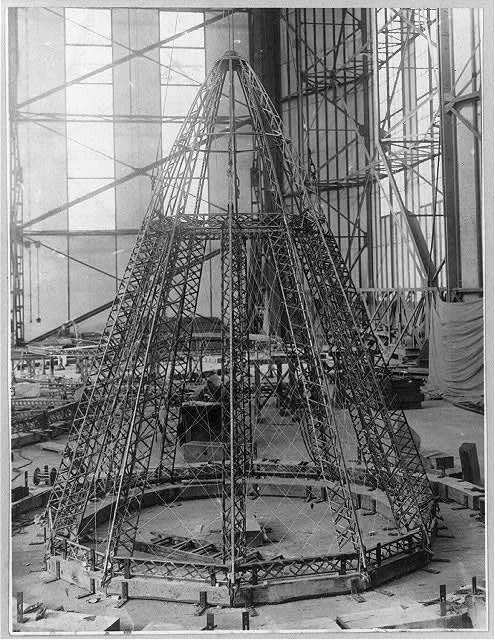

I covered some of this previously in Part 1, but here’s a recap.
Airships come in three main types. Rigid airships, or zeppelins, have several gasbags inside a rigid skeleton with a thin skin of material stretched over everything. Non-rigid airships are basically a balloon full of lifting gas, with extras like engines and a cabin hung off this. Semi-rigid airships have a proper structure (usually a keel) grafted onto a non-rigid main balloon.
It’s also worth mentioning hybrid airships which are heavier than air and rely on a bit of dynamic lift or vertical thrust to stop themselves from sinking into the ground. These are more of a 21st century phenomenon and in real life tend to be rigid.
We want our ship to be as light as possible, so we have lots of capacity for lifting plucky fellowships or crates of Gonkula berries. The weight of a structural skeleton matters a lot - so why would anyone build a rigid airship?
Non-rigid airships kind of suck
The advantages of a non-rigid or semi-rigid ship are clear. We save on structural mass, and construction is easy - we just have to make a giant bag and then inflate it with lifting gas.
The problems start immediately with that inflation step. We really want the balloon to keep its shape so the ship will handle predictably and be aerodynamic. For this we need to keep our lifting gas at fairly high pressure - around 500 Pa relative to the atmosphere (which is 101,325 Pa at sea level on Earth). This reduces the density of our lifting gas and means we need to use a thicker, stronger balloon material.
But the real showstopper is the square cube law. The surface area of the balloon is related to the square of the airship’s length, but the volume is related to the cube of the length. So as we make the balloon bigger the ratio of lifting gas to balloon skin increases rapidly. This is good news - a really big gas container has to lift less container mass - but also very bad news for non-rigids. As the ship gets bigger we have less and less skin to hold in more and more gas, so the load on the skin increases until our material fails or we have to build a thick, heavy vessel like our vacuum ship from earlier.
It turns out that if we let a structure take the load of maintaining the ship’s shape, we actually get more lift overall because we can put our lifting gas in internal cells at lower pressure, more like 100 Pa above atmospheric. We can have a number of smaller internal gasbags, which lets us sidestep the square-cube problems and allows us to build much bigger ships. And in fact once you solve this problem, the square cube law acts in our favour, and larger rigid airships are much more efficient lifters than smaller ones.
We also unlock several other benefits. Damage to one bag is less of an issue, and damage is less of a problem in general due to the lower pressure. The bags can vent gas and deform without affecting our aerodynamic profile - and we can vent gas from a single bag to shift our centre of gravity and control the ship. We have a rigid structure to mount cabins, engines, and landing gear. It’s pretty useful to be able to tuck everything within the aerodynamic hull, whereas a non-rigid has to hang its payload on the outside of the balloon. Unfortunately the common fantasy model of a hull hanging below the balloon is not great for your mileage.
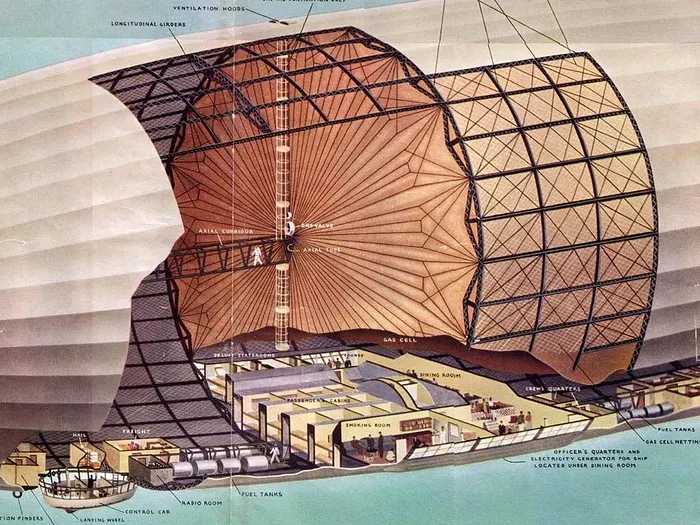
Instead, rigid airships have an exterior skin stretched over a skeleton, and then a number of gasbags inside this - on the order of ten. The gasbags are huge cylinders, like wheels of cheese stacked back-to-back, flattened on one side so that the payload can tuck into the bottom of the hull. Most of the payload is near the middle of the ship lengthwise for balance reasons.
What is the ideal shape?
By the time Count von Zeppelin was building the first real rigid airships in the early 20th century, the world had a rudimentary understanding of aerodynamics. Early airships were tubes with pointed ends, which were easy to build but not the most efficient. Instead, the ideal form is an elliptical teardrop, a “Lyon Shape”, which appears in a refined form on later airships like the Hindenburg.
To understand why and the impact this had, we need to cover a bit about drag. With an airship, our problem is how to achieve minimum drag for a given enclosed volume. We can think of our aerodynamic drag as having two components - friction drag, which scales with the surface area, and pressure drag, which is a little more complicated. Pressure drag arises from flow separation - if the back of the ship reduces in diameter too quickly, the flow of air will detach, creating a low-pressure area between the ship and the airstream. This creates drag because the pressure differential pulls the ship backwards.
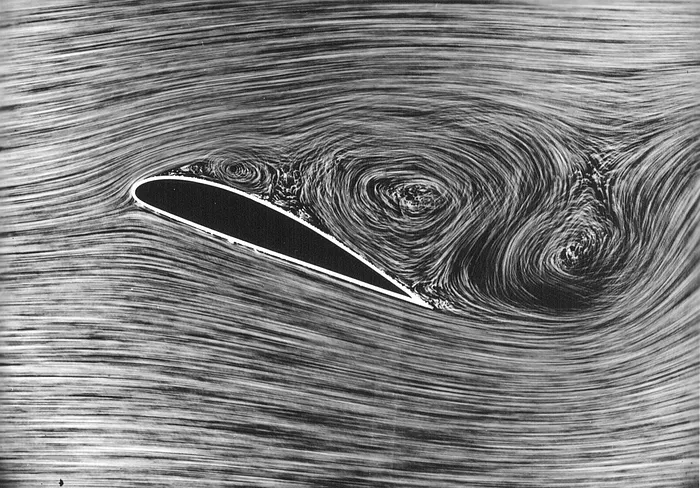

The shape with the least surface area for a given volume is a sphere. However, a spherical airship will create loads of pressure drag, so we need to taper the ship to keep the flow attached for as long as possible. You can see how the compromise between these two factors leads to the Hindenburg’s fat teardrop.
We can quantify this tradeoff with a number called the fineness ratio, which is the ratio of the length of the ship to the diameter of its widest point. Higher fineness means more friction drag and less pressure drag. Thanks to Science (TM) we know that the ideal fineness ratio for a ship like this is 6, which is borne out in reality - Akron, Macon, and Hindenburg all had fineness ratios of almost exactly 6. So the closer we get to that, the lower the drag should be.
Using fineness as a measure, we can quantify the gains you get by going from LZ-1’s pointy tube to the Hindenburg’s graceful tapering: the former has a fineness of around 11 compared to the latter’s 6, which results in two to three times less drag. And to put that into context, halving the drag lets the ship travel 40% faster with the same engine power. This also illustrates the problem with a sphere, whose fineness ratio is 1.
The double-density atmosphere we cooked up earlier doesn’t change this much, but reduces friction drag slightly without altering pressure drag5, meaning the airships in our world would be a bit longer, narrower, and more tapered than the Hindenburg. In other words, our ideal fineness ratio increases by about half a point.
This highlights another advantage of rigid airships. For blimps, the required envelope pressure for structural integrity scales with the square of the fineness ratio, which is why blimps tend to be stubbier than the rigid titans of the 1930s. This comes at a cost in drag, which is even more pronounced in our denser atmosphere because of that higher ideal fineness.
So: this sort of subtle aerodynamic shaping is important, and unfortunately for us it means that wacky fantasy shapes are going to carry an enormous performance penalty. Our ships are going to have to broadly share the same fat-teardrop silhouette as the Hindenburg, assuming their designers understand and care about aerodynamics.
However, historical designers did not always care about or understand aerodynamics. Count von Zeppelin understood that the shapes of the early Zeppelins were inefficient, but took that tradeoff because their simpler geometry was much easier to build. And in the early 20th century, flow separation and the causes of pressure drag were just starting to be understood empirically. Aerodynamics was a new science. Several early airships were built very long and thin because that’s how you build a low-drag sea ship and suffered excessive friction drag as a result. Any shape can be justified this way, but physics isn’t going to grade it on a curve.
What is the ideal size?
Because of the square-cube law, rigid airships get better the larger you build them. But is there any limit to this, or if we had enough resources would it be ideal to build a fleet of mountain-sized monsters?
Firstly, while the best airship is a huge rigid ship, a small non-rigid or semi-rigid is not a bad choice. In Part 1 we covered the US Navy’s use of non-rigid blimps in World War II to great success, which is an excellent example of this. Going big is best, but if you’re going to go small then ditch the structure.
As you might imagine, there are some problems with going big. For instance, it’s hard to coordinate a ground crew of thousands for a truly huge airship (Hindenburg already required 200 men) and the hangars required for construction become gargantuan, probably constraining our length to a few hundred metres. But this isn’t the real showstopper.
The main one is the bending load on the structure, especially from gusts. The longer you make the airship’s structure, the larger the static and dynamic loads on it. This limits your ship to a certain size based on the material you’re using for the structure. The Hindenburg, at 245m in length6, was close to the maximum size for a ship using a duralumin (aluminium alloy) structure. The square-cube law means designers want to push up against these structural limits for efficient lifting, so care has to be taken to maintain sufficient safety margin.
Here’s a rough estimate of the maximum length for some common materials:
Pure aluminum: 140m
Wrought iron or mild steel: 160m
Wood: 200m
Duralumin: 280m
Modern laminated wood: 450m (theoretically)
But this is far from the full picture. For that, we need to take a closer look at these materials.
Materials
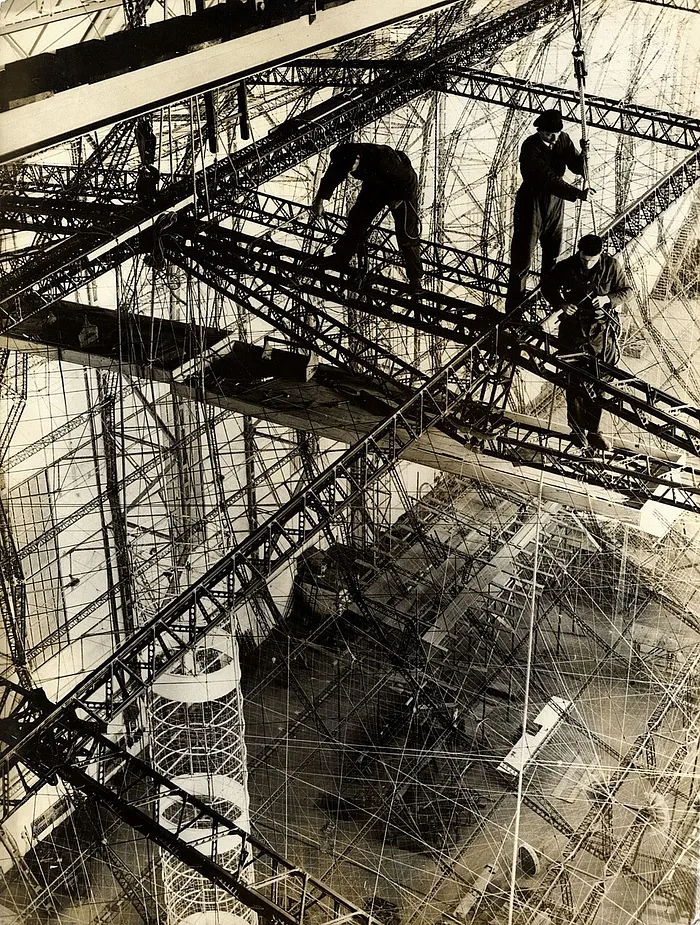

There are four main materials that go into a rigid airship. Three are relatively straightforward, and one is quite complicated to assess.
The first is the outer cover, which should be a fabric that can easily be stretched over the frame and balance tear resistance with weight. Historically, cotton with dope for stiffening was used in this role.
The second is the material for the gas cells, which needs to be extremely low-permeability (blimps can just use a strong, tear-resistant outer balloon with an inner lining of low-permeability gasbag). Animal intestine was used in this role, which was extremely expensive, before being superseded by gelatin-coated cotton and plastic films.
The third is rigging material, i.e. cables that will be in tension. Normal material requirements apply here. We want something with a good ratio of yield stress to weight, so steel cables are a good bet.
And then there’s the structural frame.
The frame is by far the heaviest part of a rigid airship, so the material used here is very important. If it’s too heavy, we’re not going to have room for any payload. Every kilogram of weight we save translates directly into payload or, in other terms, requires hundreds of litres of hydrogen to lift.
Frames also have unusual material requirements. Below a certain size, the key difference is that compression failure is the limiting factor, not tension failure. This is the opposite of almost all human-scale structures; airship frames are like this because they are enormous and thin relative to their loads, which are quite low. Airship hulls also operate at these low stresses continuously for years on end - they are nearly always holding the lift and weight of the ship, as opposed to aircraft, whose wings and structure only support their weight during flight.
So we are not concerned with normal measures of material strength like yield stress over short periods; instead we want materials that will provide stiffness, i.e. buckling resistance, for decades without degrading. And we want that stiffness for as little mass as possible.
The major surprise here is how impressive wood is on paper. Steel beat wood for most applications because it was easy to produce industrially, it didn’t decay, and it makes up for its weight with very, very high yield stress. But wood has been optimised by nature over millions of years to be the best possible material for tree trunks… which are compressive structures that are huge relative to their loads and must endure for decades. Good-quality laminated wood, bamboo, or aircraft-grade spruce absolutely dominate in structural performance here. Their stiffness per kilogram is several times that of steel and aluminium (including alloys like duralumin).
The statistics are good enough that of course someone tried this. Schütte-Lanz built a few rigids as a competitor to Zeppelin in the early 20th century, mainly distinguished by their wooden frames. There were genuine performance improvements from these, but the main legacy of the SLs is their string of failures. Insects and fungus ate the wood; the ships could not operate over water or in humid areas due to moisture, which degraded the frame and softened the glue at its joints.
Wood has other problems, too. In many ways it’s less repeatable than aluminium: grain patterns vary from tree to tree, and glued joints are less easily standardised compared to riveted aluminium. Across a whole fleet of airship frames, this matters.
And then there’s that caveat: below a certain size. That size is a couple of hundred metres, after which aluminium alloys start dominating because of their better strength per kilogram. As the ship grows, those small stress loads grow until strength starts mattering again. But steel is always a terrible choice because it’s so heavy - if you don’t have access to aluminium, you’re probably better off with 200-metre wood ships. Aluminium has its own issues, chiefly the fact that you need advanced industrial technology to produce it at scale.
We can imagine various interventions to help with this. Our drier planet from earlier already helps mitigate the moisture problems of wood. Some sort of sophisticated coating or glue would also help here, which would surely be found dripping from the fangs of some terrible creature.
As for aluminium, hydrangeas get their blue colour from absorbing aluminium compounds, so it’s not too much of a stretch to imagine a plant that concentrates the metal in a pure form. And electrolysis just needs a lot of energy, regardless of whether that’s coming from a spellbook or coal.
For airships without access to 21st-century materials, aluminium and wood are going to dominate. If we’re talking about a contemporary or near-future context, you might notice that a lot of the modern semi-rigid designs like the Zeppelin NT use carbon fibre for their frames (more on this later), because these are more typical loadbearing structures compared to the frames of early, small Zeppelins. Maybe the only original thing I have to offer here is how competitive wood is with the best modern materials in the buckling regime, at least in terms of raw numbers.
Magical materials
I think one excellent application of magic to a fantasy airship is in the provision of magical materials. Unlike magical lifting gases, there’s lots of room for physically plausible super-materials, whether these arise through fantastical or scientific means.
Wood is a composite much like carbon fibre reinforced polymer. Its fibres are incredibly strong, in the same neighbourhood as Kevlar, but they’re undermined by imperfections and weakness in the matrix that binds them. More perfect wood could beat duralumin’s performance in stiffness and strength several times over - this is something we can already sort of see in densified wood produced in modern labs. Fictional wood with a more ordered matrix is perfectly possible. To a decent approximation, making wood strong is really a matter of improving the matrix.
Ultimately, the strength of wood is set by the strength of the carbon-oxygen bonds in its fibres. There isn’t really any way around this: forging new carbon-carbon bonds (which we’d need to do to improve on this) is very energy-intensive at room temperature, which is why the tree breaks down CO2 into small carbon fragments which are joined by oxygen. For true super-materials you’d need some sort of magical furnace.
Are vacuum airships a good idea now that we can have magic materials that do whatever we want within reason?
No.
Blimps are… good?
One interesting case to consider here is if you have access to very strong envelope material but only normal structural materials - say, for instance, the skin of some magical beast can be repurposed as blimp material, but a rigid structure would still need to be made out of wood or aluminium.
Returning to the size discussion on rigids from earlier, the skin of a blimp still has to carry bending loads from gusts as a “beam”, but with very strong envelope material you could build larger blimps than the biggest possible rigid ship. This has the added advantages of massive weight savings from the lack of structure and massive cost savings in construction. However, you would likely still want some sort of keel or internal structure to distribute point loads from the gondola and engines and possibly divide the envelope into multiple gasbags. This semi-rigid structure is the approach many modern airship programs have taken.
Don’t underestimate structural analysis
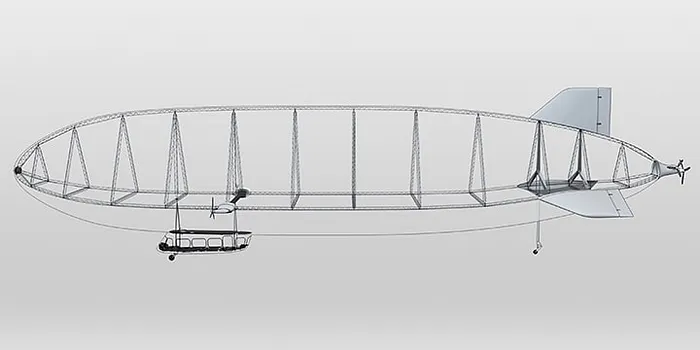
An airship structure is very complicated. If we’re using an optimal shape like we discussed earlier, it’s a whole bunch of giant complex curves made up of thousands of individual struts. And we need to analyse it.
First, we can’t really do iterative testing instead of analysis on whole airships. They tried this on the early Zeppelins because Dürr, the designer, was a sort of 20th-century vibe coder (he was a savant machinist but initially refused to learn analysis techniques). It was expensive. Without any structural analysis, we also can’t have much confidence in our design, and we’re probably leaving a lot of payload on the table - assuming we can take off at all.
This analysis is the sort of thing your MacBook can handle today, but without computers it’s pretty tough. You need fairly advanced materials science and mechanical theory. And the calculations will consist of pages and pages of laboriously worked-out tables, probably handled by specialised human “computers”.
How do we actually build it?
This is going to be an enormous undertaking and require a building the size of the airship itself. The airship hangars of the 20th century are among the largest enclosed structures ever built; some had their own internal weather systems including occasional clouds. So you can imagine the expense of constructing these to begin with, the amount of scaffolding required for airship construction, the difficulty of getting around within the hangar, and so on.
Aluminium alloys could not be welded in the 20th century, so every joint on the frames of the big rigids was riveted by hand - they all had to be accessible, and the rivets had to be hot when driven, so they were heated red-hot and often literally thrown over to the crews driving them in.
There was also a lot of tacit knowledge living in these workshops, which was one reason the Zeppelin company was able to hold onto its technical monopoly for so long. Ways to get wires tensioned just right, accessible rivet positions, bodges and workarounds for tolerances that didn’t quite line up after dozens of successive joints, and so on. Every rigid airship was an individual work of art and one of the most impressive construction projects in human history.
But let’s assume the plucky denizens of our world manage it. Now they need to make it go somewhere.
Fuel and engines
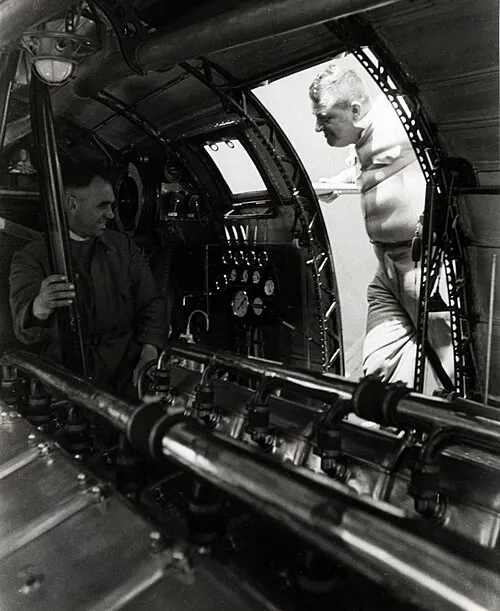

As we covered in Part 1, engines are an extremely important part of an airship. We need engines that have a great power-to-weight ratio and are also very powerful in absolute terms to overcome forces from the wind.
Let’s begin by covering some things that won’t work.
Sails do not work
You may be tempted to put sails on your airship. It looks lovely, but I think it’s something of a trap if you’re aiming for rigor in how your ships operate. The trouble is that you are the air.
We want to generate thrust from sails. But they only generate thrust from relative wind: imagine feeling the breeze rushing across the deck of a ship. You don’t get that on an airship, because any relative wind is going to shove you around until you’re travelling with the breeze, unless you have engines. This happens very easily because you’re the same density as the air around you and your hull is enormous, so there’s a nice big surface for the wind to shove on. An airship is already an enormous sail.
Sea ships also benefit from living between two worlds: the extremely high density water they sit in and the low density air that blows into their sails. This lets them take diagonal breezes and cancel out the sideways component with their keel pushing against very heavy water, but exploit the forward component. It’s this basic principle that enables things like tacking into the wind. Something like this is impossible in an airship, unless you wanted to engineer some sort of airship that sails at the transition between a high and low density atmosphere somehow… but you need wind for sails, which is going to keep the atmosphere mixed. And even then sails would be far, far less effective: water is about 800 times the density of air, and here we are celebrating a 2x increase in density with the air pressure trick. Even a ship which is heavier than air but stays aloft from constant upward thrust, like a helicopter, will be affected by this issue, though it’s more robust to being thrown around by gusts.
So airship sails let you go where the wind does more effectively, but even then not really, because your hull is going to be a more effective sail and you’ll end up going everywhere sideways. There are two other problems:
The sails are going to experience large forces during gusts, which complicates your already-fiendish structural engineering problem and forces you to make your ship heavier. Remember how the number one problem for airships is being demolished by gusts?
Even if you do have engines to back up the sails, the sails and their masts etc. are going to hugely increase drag, even if the sails are furled. This also makes low-speed manoeuvring and berthing, which is very dangerous for airships, much sketchier - it’s easy for these protrusions to catch gusts low to the ground.
If you really wanted to max out fuel efficiency, maybe you could rig some sails on a powered airship that were only deployed when cruising in a tailwind. But this is significant additional mass for very marginal benefit, and I note there are no examples of real-life rigid ships doing this.
Human power does not work
Now, at least here we’re getting some of our power for free, by using our passengers as a resource. And this almost works - using pedalling people to power a preposterously proportioned propeller (the most efficient way to do it) means you can actually drive a small airship at a few kilometres per hour.
The problem is wind, which is going to do whatever it wants with you; the human drivetrain just doesn’t generate enough power to overcome gusts pushing the envelope around, no matter how many people you add (which of course makes the ship larger).
Steam kind of works
In real life, steam engines had the power to push an airship around, but they were just too heavy - and then they were outperformed by combustion engines. But remember, with the new atmosphere our Hindenburg analogue goes from 110 to 330 tons of payload. Now steam has a chance.
“Steam engine” is a broad category because a lot of technological development has been compressed by history. The earliest steam engines were far too heavy to ever work in an airship application, but 1930s ones could have worked on something like the Hindenburg, albeit with major compromises in top speed, range, and payload (cutting all of those in half would be the ballpark).
The other thing is that “steam engine” implies coal power to most people, but of course you can use anything to generate the steam - oil, wood, a nuclear reactor.
And how do you convert the steam into work? Pistons were dominant until the late 19th century, and by the first years of the 20th turbines had taken over - but in the airship context we want to stick to pistons so we can directly drive a large propeller at low speeds. The pistons can also easily reverse and work better partially loaded, which is handy since we’re not going to be full throttle all the time.
We definitely want water as the working fluid - it’s incredibly good at this, which is why modern power stations still use it. Plus we need the water for ballast anyway.
Our denser atmosphere also helps steam significantly. We have more lift to spend on heavy steam boilers, and the higher pressure means that condensers can be much smaller, as it’s easier to reject exhaust heat to the denser air. This also means we can recover more of our feed water using the condenser; a major benefit, as otherwise we are venting water into the atmosphere, which cuts into our payload.
Steam engines in this world would be about 70% as heavy and slightly more efficient (around 10%) at the same time due to more efficient combustion in the higher-pressure atmosphere.
In our application the only real variable is the heat source. Coal and oil are the two competitors here. Both of these would become viable power plants in the new atmosphere, though not great ones. Airships powered by these would be able to achieve around double the range relative to our world due to the gains we just discussed, with oil benefitting more (it’s more like 2.5x) partly because its hydrogen content means condensing recovery works better.
Consider a Hindenburg-sized ship in our new world with 14,000km of range. Cruising speed would be a bit lower than the real Hindenburg’s 135 kph because the denser atmosphere punishes fast flight. Let’s call it 100kph, which halves the required cruising power from 4 to 2 megawatts. Now we can size our steam powerplants. We could expect a coal powerplant, plus fuel, to weigh around 160 tons in our new atmosphere. For oil this is around 110 tons.
Even the oil powerplant uses the entire payload of the real Hindenburg, but in our new atmosphere we still have hundreds of tons to spare. This is absolutely something that can work, even on smaller ships using less advanced steam engines. The key is condenser technology.
Remember, though, that a boiler is going to be a huge fire risk, and that a coal airship is going to be dumping loads of coal ash along its route - bad news for anyone living below.
Finally, if you have some odd heat source - magic, a bunch of uranium enriched using fae folk knowledge, whatever - then you could achieve performance so good you need never develop the combustion engine. But remember what we covered earlier about those lift crystals being an Industrial Revolution in a box?
Combustion works
Now this is what all the real airships used. Rather than using fuel to heat water and steam to drive the propeller shaft, we could just use the combustion to drive the propeller directly. Internal combustion gets us engines that are powerful and light while using fuel that’s extremely energy-dense.
But there are reasons these weren’t good enough for airship applications until the early 20th century. They required relatively precise machine tools, which were the result of a long line of technological development involving tools making slightly more precise tools over and over again. This is not to mention oil refining, high-quality materials, and various other prerequisites. Every part of the rigid airships of the 20th century required a lot of science to construct, but their engines were probably the most technologically advanced component.
There are a few details that matter here. For real-life airships, cooling and aspiration were problems: airships flew slowly, so there wasn’t much air flowing over the engine to cool it compared to an airplane, and at high altitudes there wasn’t much air for the engine to breathe. Many airships used superchargers to force more air into the engines to overcome this, but these created their own heat problems.
Thanks to our double-density atmosphere, this picture is a bit different. Cooling becomes a lot easier. Superchargers or turbochargers become very attractive because you’re drawing a lot more inert gas into the cylinder, which acts as a heat sink and lets you force much more air into the engine and run it at higher pressures before fuel starts prematurely detonating. But that same inert gas reduces performance a bit in engines without forced induction.
The main question when it comes to combustion engines is the choice of fuel.
We don’t necessarily want the fuel with the highest energy density. One problem early airships had was buoyancy compensation: you take off with tons of fuel, burn it during the journey, and have to vent a lot of expensive lifting gas on every trip just to hold position. The solution the Zeppelin company came up with was Blau gas, similar to propane, which in gaseous form has almost the same density as air. It was used in the Graf Zeppelin, which as we saw in Part 1 was among the most successful airships ever.
But this was abandoned for the Hindenburg in favour of diesel. That convenient density meant that 30% of Graf’s envelope was fuel. On top of this, diesel engines operated at 35% thermal efficiency compared to the 25% of Graf’s Blau engines. Diesel is attractive for safety reasons as well. Gasoline passively vents ignitable vapours; diesel is so inert at room temperature you can put a match out in it. Gasoline requires an ignition system inside the engine; diesel does not.
So diesel is a pretty clear choice for combustion engines if you have the requisite technology. A 2MW diesel powerplant for our earlier example would be around 60 tons.
There are a couple of other things worth considering regarding combustion engines.
Firstly, water recovery. This was something that the USS Akron and Macon both had, because they used helium for lift and had combustion engines. Helium was expensive enough that it couldn’t just be valved all the time to make up for burnt fuel, so it was worth it to use several tons of payload to fit systems that would condense water from the exhaust and return it to the ballast tanks. An optimised version of this could get pretty close to the buoyancy compensation effects of Blau gas - diesel produces around 1.1kg of water for each kilogram of fuel burned. This was planned to be installed on the Hindenburg, but it was dropped when plans to fill it with American helium fell through. The system was eventually fitted to her sister ship, the Graf Zeppelin II. In a world where combustion-powered airships are common, it seems like these systems would become optimised and ubiquitous.
The Hindenburg also considered hydrogen-burning engines. Obviously it’s advantageous to burn a lifting gas, but you can do better than breaking even because a hydrogen engine has an exhaust that’s 100% water - your engine actually doubles as an airborne ballast production plant which you can tap at your leisure. This was also dropped: hydrogen is notoriously hard to use as a combustion-engine fuel, it leaks everywhere, and even modern hydrogen combustion engines for cars perform poorly. The idea of enriching the hydrocarbon fuel mixture you’re using with extra hydrogen, however, might have some potential in applications where you really want to maximise ballast recovery.
Electricity could work
By the late 1800s, practical AC induction motors were available that hit 80% efficiency at 100 W/kg at the top end. This sounds great - our 2MW of engines are only going to weigh 20 tons for cruise using 1890s tech. By the middle of the 20th century this had increased by another order of magnitude and the best motors were approaching 1 kW/kg.
Of course, the trouble is batteries. Electric motors have always been great, but it’s only in the last couple of decades that batteries have improved enough to make the electrification of everything a viable proposition. Electric airships with historically-accurate battery technology in the 19th or 20th century are and were a non-starter.
So how could we get batteries that are good enough? We need something above 2000 Wh/kg to see similar performance as our hydrocarbon options - equivalence with the diesel powerplant would require well over 3000. This is ten times current lithium-ion performance and well beyond any near-future speculative technology. We’re going to need to bring in the wizards.
The best way to set this up while staying as close to real physics as possible is using some sort of metal-air battery. A battery consists of an anode, cathode, and electrolyte; the anode loses electrons, the cathode gains electrons, and this reaction happens through the bridge of the electrolyte. The idea is basically to have a metal anode react with oxygen in the air (which acts as the cathode) via an electrolyte applied to the metal. Aluminium-air batteries are real and achieve around 1000 Wh/kg; it’s not too much of a stretch to imagine a fictional metal that works well in this application and achieves much higher energy-density (lithium-air could theoretically get to 11 kWh/kg, but lithium has a lot of practical problems).
These would not work like the batteries we use today. Instead, they look like a huge stack of metal plates coated in alkaline electrolyte that are slowly eaten away as they discharge, producing hydroxide sludge. You could estimate the remaining charge by looking at the thickness of the plates. Rather than recharging, spent plates would be smelted down with their waste sludge and re-forged into fresh batteries. The process would use very similar technology to the electrolytic process for producing aluminium.
Biology is always an option, too. Evolution could plausibly produce a battery advanced enough to meet our weight requirements. Some sort of battery organ harvested from a fantastical creature could be connected together in stacks of cells to produce the power required for airship engines. The batteries would literally be alive: recharging would probably involve feeding them some sort of glucose slurry.
With these options at 4000 Wh/kg (of course you can always set this number higher with a handwave) we’re still looking at a powerplant around 120 tons for comparison with our earlier options, including 105 tons of batteries. There are other obvious advantages to an electric powertrain that would maybe tip the scales in its direction, however - the efficiency at all speeds, the instant torque, the lack of emissions, and so on. On the other hand, sparks would have to be controlled with great care.
Of course, as we get deeper into the magical side of things, this all becomes a matter of your own judgement. Magic engines will always work; all I ask is that you consider where they could work outside of airships, too. For instance, both of these proposals would lead to an industrial society that skips hydrocarbon fuels and combustion engines to go straight to the electric tech stack, like the one depicted in Planesrunner.
Putting it all together
In summary, we have a planet that is quite different to Earth. Its atmosphere is twice as dense, it’s drier with smaller oceans and flatter mountains. It has mild seasons and possibly days several times the length of Earth’s. Its weather is mild and more predictable, concentrated around dawn and dusk.
Airships arose here in the early industrial era, beginning with unpowered balloons that soon developed into primitive steam-powered dirigibles. From there rigid airships were born that could begin doing useful work, starting with tourism and sightseeing but rapidly developing into mail and passenger lines for the well-to-do. They grew larger - up to a couple of hundred metres in length - but were limited by the material properties of wood.
From there, maybe they kept going down the combustion-powered path. They developed more efficient oil-powered steam engines and then combustion engines using diesel and water recovery systems. Maybe the combustion transition never happened because some sort of magical heat source for steam dominated. Or maybe combustion was never a serious option because of naturally-occurring material perfect for advanced batteries.
Regardless, at some point a better structural material would become available. Maybe that’s aluminium alloys, which could push the ships out to around 300 metres in length. Or maybe it’s something not found in our world, like an ultra-strong wood that could enable even larger rigid airships.
Regardless of the size of the rigids, there would likely be a place for small non-rigid or semi-rigid blimps that use keel frames in specialised or regional applications. All ships would be hydrogen-filled.
The largest rigids would be able to haul payloads of hundreds of tons across continents in a matter of hours, enabling a global network of passenger transit and logistics. Their journeys would happen at cruising speeds around 100 km/hr; and they would fly low, often just a few hundred metres above the surface, as ascents would have to be carefully managed to avoid incapacitating the crew.
They would share the tapered-teardrop shape of the largest rigids in our own history, but be slightly more tapered, coming closer to this shape as the world’s aerodynamic science improved.
This all sounds pretty nice. But what does this world actually look like? How would a society built around this airship transit network look? How do you actually fly an airship, and what would their crews be like?
That’s where we’re going next week in the final part of our survey.
For reference, the coolest parts of the sun’s surface are around 3500°C.
↩If you write the ionized plasma airship fantasy novel, I promise to buy it.
↩This is because pressure is basically the momentum transfer of particles whacking into the sides of the container. Compare a gas like hydrogen with very light particles to oxygen, which is heavier. At the same temperature the hydrogen and oxygen particles will have the same amount of kinetic energy, meaning the hydrogen particles will be traveling much faster and hence colliding with the container walls more frequently. The oxygen particles will be traveling slower, but each impact will transfer more momentum. These effects exactly cancel each other out; so if each particle contributes the same amount to pressure regardless of mass, two volumes of gas at the same temp and pressure must have the same number of particles.
↩The main effect of this would be the heat. This world would have a huge amount of potassium, which you can use for all sorts of things, particularly fertiliser. All that K-40 decaying would produce a lot of radiation, but this looks more like elevated cancer rates than a wasteland. However, the decay would also create a lot of heat in the crust. That means more volcanoes, probably a denser atmosphere due to outgassing, difficulties with mining, and geothermal energy you can easily tap by drilling anywhere on the surface.
↩This is because the density of the air affects the Reynolds number, which changes the characteristics of the boundary layer, making it thinner and more efficient at handling the velocity transition between the air and the ship’s skin. This reduces friction drag by 10-15%.
↩Since we’ve established the ideal shape, it’s easier to talk in terms of length.
↩