Blinker
"It was a wonderful day to be building magnetohydrodynamic drives."
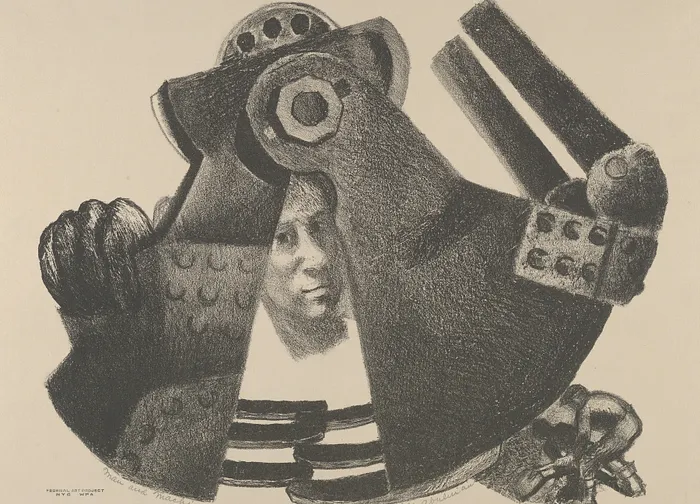
It was a wonderful day to be building magnetohydrodynamic drives.
Zac Peakes did not walk: he strode. He was moving against the flow of the foot traffic, hemmed in by the artificial canyons of downtown, but he never slowed or hesitated. There was a technique to it. Staring straight ahead, moving with a certain kind of conviction. Never making eye contact. And all the people hurrying to their tasks parted like a school of minnows.
Not minnows, Zac chided himself: they were important in their own way. Society’s structure made the MHD possible.
“The world is a museum of passion projects,” he muttered under his breath, then shook his head, short and sharp. Focus. Ninety days. That was how much time Leviathan Marine Incorporated had left until they wouldn’t be able to make payroll. They had a demo in sixty, and half a year of technical problems to solve before then; as the CEO, it was Zac’s responsibility to somehow chart a path through.
The sun was furtive, striking out from behind the hills beyond the bay. Light scattered and lanced off glass facades far above Zac. He was like a molecule of seawater in an MHD, the buildings vast electrodes, and they propelled him with the inexorable force he had had at his back for two years now. Ever since he had started his blinker fluid prescription and realised that all he wanted to do was build magnetohydrodynamic drives - wanted it so much, it physically hurt to do anything else.
Turbulence: his phone was buzzing against his thigh. He ducked into an alleyway and stood across from a dumpster that was pungent with the stink of decay. Zac barely registered the smell. It was an investor, a venture capitalist, calling him back.
“Go for Peakes.”
He cocked his head, listened more intently, though Zac did everything with intent, so this was more of a concentration, like concentrating conductive ions in --
“Okay,” Zac said. “You can do more than that. Another two million.” You had to be firm with these people.
There was silence for a moment as he listened.
“Yes, I understand, but look, are you a contrarian or not? You know the potential here. I mean, we’re talking about the arc of history. Your words, not mine. Not spreadsheet chump change. Do you want to be - “
Cut off, Zac began to pace in a tight circle between the wall and dumpster. The dumpster was skewed, offset from the opposite wall by about fifteen degrees. This greatly irked Zac.
“Well, thank you for your time,” he said, and hung up.
“Not,” he muttered under his breath, already moving for the street. Ninety days.
Twenty minutes later he was shouldering his way into Leviathan’s combination of open-plan office and machine shop. The scents of hot metal, sweat, lubricant, and coffee greeted him. Parts strewn everywhere, labels boxes MITUTOYO FEEDRATE OVERRIDE NO OIL 7/12/28 ENTANGLEMENT HAZARD MCMASTER-CA-- and in the middle of it the shrine they had built: the prototype.
Its edges glittered, jewel-like. A strange thing. Something summoned.
He considered it for a moment that seemed to last for minutes before heading for his team. The morning would be spent in discussions with the rest of the company, encouraging, unblocking, berating, always pushing for more speed and less cost. Within these four walls their vision was subtext: make every waterborne vehicle from tug boats to supertankers obsolete.
This was easy. Those ships used propellers, whose shape was a compromise running in a poor flow regime. They were powered by internal combustion engines, which turn fuel into heat and smoke; as a byproduct, they spend a little energy turning a driveshaft.
Some were already replacing marine engines with electric motors. Zac respected and pitied these people: right direction, but why bother moving a conductive fluid mechanically when a magnetic field would do the trick? Leviathan was not in the business of optimizing something that should not exist. A vehicle whose only moving part is its medium. This was the promise of the MHD.
Of course there was the failed Japanese project from thirty years ago, pictured in an enormous poster that covered one wall of Leviathan’s machine shop. A reminder that they must do better than the best.
Because it really was an impossible problem. Zac could not see a way through yet he knew it was there. His conviction was absolute. He could not see into the fog yet he put one foot in front of another, trusting in the path to continue, for he knew it must exist; he knew that this very knowledge brought it into existence. Zac was calm. Say that again: Zac was calm.
First order of business: their morning dose. The eyes of his team smouldered and tracked his face, unwavering. He was surprised when they blinked. His view of the world was a fisheye, distorted around the focal point of this factory, and it felt amazing. Across from him the letters on Asher’s keyboard were tiny but clear, precise, and their detail took his breath away.
They produced their bottles of fluid with relish. In the beginning Sam had joked about this being a ritual. They didn’t do that anymore.
Castalia Pharmaceuticals’ Neuroflect product, commonly known as ‘blinker fluid’, produced in patients an intense obsession with a particular subject, with a few manageable side effects. Zac and all his co-workers had signed up for a coordinated course two years ago. They all agreed this was the best decision they had ever made.
Zac tilted his head back, exposed his sublingual papilla like a wolf baring its throat, and squeezed the dropper bottle once, twice, three times. The blinker fluid stained the skin under his tongue purple. He shook his head again - that short, sharp motion - and was focused once more.
That was the signal to disperse. They knew what had to be done.
He’d barely launched into the day’s first challenge when his phone intruded again.
“Go for Peakes.”
The voice on the other end was familiar but irrelevant. Zac listened for a few seconds in case anything changed, then hung up and berated himself. Not for the tiny slice of time, but the break in focus. It’d take him another five minutes to re-immerse in Deep Work.
He was designing a part because it was important that technical managers, and that included the CEO, spend at least twenty percent of their time doing the job that they manage. The part was a segment of the inlet and there were several important design considerations. There was another important consideration, which Zac remembered now occurred to him from time to time. Somehow his memory had been jogged by that call just now. But he always forgot, afterward, and didn’t think about it. It seemed important, though, which must mean it was critical to the success of the firm, so he looked away from his monitor and frowned, chasing the elusive concept. Slowly it solidified until it was as clear as the letters on Asher’s keyboard.
He remembered a girl, freckled and covered in sand, walking alongside him in a wetsuit with a surfboard tucked under one arm. They were on a beach, wet sand like glass as the sun set over the ocean. A rocky promontory rose ahead, riotous with greenery.
She had looked over at him. No, her name was Cassie, and that was important too. Cassie looked over at him and grinned.
“My uncle has this yacht, y’know,” she said, “nice big fifty footer. He’s too old now to take care of it. We should totally buy it.”
“I’d rather have a house that can’t sink or break down,” he said.
“No, hear me out. We get some guys together. Us, plus I know Jen and them would be down. You could ask Asher and Tom. We pool our money,”
“Ha ha.”
She punched him on the shoulder.
“Pool our money, quit our jobs, fix it up, get comfortable, and head into the Pacific.”
“Cassie. OK, I get it. That would be awesome. But you haven’t sailed since, what, senior year? None of us know how to fix a yacht!”
She laughed. “But we can learn. And if we’re going to do something we might as well do it properly. Everyone hates their jobs, we need some time off, a chance to pivot, you know?”
She smelled like sandalwood, he remembered suddenly.
“Okay,” he said, laughing too, “okay, sure. Let’s buy the damn boat.”
This had all happened before Leviathan - he was certain. But then, Zac thought, they had not bought the boat. Why had that happened? There was a twinge of pain in his chest. He felt that was important too, in fact the most important thing of all, but clearly this was irrelevant, no, ninety days, remember, MHDs, the part, the part, the part!
The inlet, yes. He’d removed some fasteners and simplified the structure, reducing mass and cost, but now he needed to see how those changes affected the water coming in. Leviathan’s prototype was targeting a water velocity of ten miles an hour through the throat, but turbulence and eddy currents could easily cut into that. Ten miles an hour. It didn’t seem like much, but water’s sheer density meant that was a serious amount of momentum, just like the truck; though it had only been going thirty it had still been enough to turn the front of the car into something unrecognizable --
“Z,” Asher said, “you good?”
“Sure, sure.” he rubbed the back of his neck. “Just waiting for this run to finish.”
“Ok, just looked like you zoned out there, is all. We’ve got some results back from the power testing, want to have a look?”
“Let’s go.”
They all agreed the initial results were promising. Zac had to leave early: the documentation for their test licensing was due that night. But he’d barely sat down when someone approached his desk. Recognition took him a moment. It was Jen, who hadn’t been into the office for a couple of days.
“I quit,” she said, agitated.
Zac peered at her. “Let me see under your tongue.”
“No! I’m off all that stuff, that’s exactly why, can’t you see what this has -- well, of course you can’t but,” and then Zac tuned out. Easy and smooth. A bunch of gibberish that soon blended into the background as he prepared her severance documents. She tapped him on the shoulder, and after that he feigned attention, recognizing this would speed the process.
On the way out she did things, said things, that seemed to increase along some axis. But Zac was insistent and soon she was out the door. After that, well, he’d already disabled her access.
Afternoon became evening; he had come to love the ambience of an office at night. The dead and open air. Light stark against black windows. Watching the skyscrapers downtown blend into the darkness pixel by pixel. Soon the building was empty, his employees off to test in the field or sleep. But Zac stayed, immersed in his private universe. Matrices unspooled before his eyes.
His reverie broke just before midnight. Someone was there at his shoulder he recognized without recognizing, like a minor celebrity, but that strange moment shattered as he was grabbed and handled. It took Zac too long to begin fighting back. By the time he realized these people would stop him working he was already on the way to the door.
As they emerged into the glare of LED streetlights he was writhing. They had him locked down like a superconducting magnet in its housing, and hustled him quickly into a waiting van. He squeezed his eyes shut: some of these people physically hurt to look at. Quiet voices spoke around him like a language that he hadn’t spoken in years. Zac took in the smell of old dirt for a moment before they pushed him onto a seat. The way they moved him was too gentle. Not extortionists, then.
The van was amateur. Scratched plastic, tired seats. Clearly rented. The internal combustion engine droning up under the cab irritated him, an itch he could not scratch, cloying inefficiency. He looked at a couple of the people in the background, who didn’t blur or hurt his head to see; they seemed more like curious students. The face in front of him was moving. It was saying something. Slowly he came to understand; Zac was unsure if he wanted to. But the words arrived regardless.
“--’s tomorrow. You’ve got to be there, Zac. This won’t be forever. So, like, I guess you want to be this guy. But not tomorrow.”
“I need to get back to work,” he said.
“See, it’s working. He’s responding to me.”
One of the onlookers, one Zac couldn’t see properly, said: “Still a robot.”
“If he was hopped up on fluid we’d just sound like static. It’s in the FDA release, remember?”
“Seriously,” Zac interrupted them, annoyed at being forced to listen to something so derivative, “there are critical path milestones this week. The team needs me on the ground to --”
“Quiet,” said Familiar Face, not unkindly, and another voice from behind him said, “can’t we get some tape or something,” before the familiar voice hushed them.
But Zac was used to dealing with outsiders and he shifted smoothly like a drive array reversing polarity. “What do you want from me? Let’s work something out, skip all the precursors, what’s the number?”
“There’s no number. You’re coming with us, Zac, and we’re going to the,” the last word was unintelligible.
He awoke a stranger to himself.
The first thing Zac did was turn over to the limits of his restraints and vomit over the side of the mattress. His handler scrambled up, yelled for help - and Zac heard all of it. All the sounds of the house, steps on the stairs, cutlery clinking, birds fussing in the branches outside; it all made its impression without filtering or consent. The world broke over him. He lay there, limply. Something else, too, more than memory, an entire person within him who had been silent and now was clamoring for attention.
He spasmed again but brought nothing up, just the rawness of acid in his mouth and the straining of his stomach. By now there were people around him and he felt their hands, heard their voices, they pressed themselves upon him He looks pale Is it all gone What’s wrong Tom let me help with We’ve got some in the basement and he moaned like an animal because the memories were there and they would not be denied.
He remembered throwing up the night Cassie had died, too, leaning against the wrecked car as it ticked, watching as leaking coolant pooled around his shoes. It had mixed with the bile and the blood. He did not want to look at the people helping him now, just as he had not wanted to look at her then. Cass had only been twenty-four. A person should not be allowed to die like that, he thought, before they had even learned how precious each day was.
After that the boat plan had fallen apart. Actually their whole group had fallen apart. Cassie was just one of those people who kept a scene together, and they were invisible until that glue was no longer there. It had hit Zac especially hard - God, it was hitting him hard now all over again. They had been dating and it took every ounce of his willpower to keep himself away from those memories. So, the blinker fluid.
Things began to unravel. Had he imagined Leviathan? It shocked him doubly: that he could even think about Leviathan now, and that he could think about it in such terms. Of course it was real! It was realer than real, and he almost shouted that at the people now propping him up and cleaning him, but in his heart it rang hollow.
He felt new to movement, but they helped him across the hall into another room, and left him alone with Tom. Good old Tom from college, the only person he’d kept in touch with right up until walking in Castalia’s front doors. He hadn’t changed a bit - same ganglyness, crooked grin, mouth turned down slightly at the edges, and narrow-set brown eyes.
They smiled at each other uncertainly for a moment. Motes of dust danced in the light. Then Zac staggered forward, Tom coming up to meet him, and they embraced each other. They’d never hugged before, but it seemed right now. Zac let his sobs subside, shaking his whole body, turning his face into a mess. He found he couldn’t stop apologizing: for leaving everyone, for being a coward, for getting tears on Tom’s shirt.
“Shut up,” said Tom fiercely, “it’s okay. I’m just glad you remember.”
At the memorial they sat in the front row. It was a bright, blustery day, and the voices from the podium wavered, drifting in and out of clarity with the wind. Distorted like… ripples in a pond, Zac thought lamely.
Cassie’s parents were seated next to him; her mother had nodded to him sadly, from a distance, but her father rebuffed his tentative introduction.
“You’re not the Zac she was with,” was all he’d say, with a strange mixture of contempt and pity in his eyes.
Zac thought about the lawns along the shoulder around them and that someone must mow them. He wondered who they were, and if they saw the dignity in their work.
Up in front the presentations were wrapping up. Some local politico posed with scissors, smiled for the camera, and returned to the podium to announce the official opening of the Route 180 Smart Road Networked Upgrade. A program manager had said “SRNU” with a straight face earlier.
“...autonomous vehicles,” he droned on, “will now have all the data they need to form a complete picture of their environment, and head off situations like the one that left us without Cassie,” Zac winced, “before they even have a chance to happen.”
This was what progress looked like, he supposed. This was the part you saw: it seemed boring and incremental, insincere. All the work to deliver it was invisible. But nobody would see the things that wouldn’t happen because of this project. Silence and stillness among the low bushes along the shoulder.
There was catering afterward, free to the attendees. Zac tried to speak to her parents again, only to find they would say nothing to him and he had nothing to say in turn. Really they had said it all when it had been raw; all of them had had enough of empty platitudes. Add to that the fluid, and her father’s attitude… He gorged himself on sliders instead, juice dripping down his chin, finding his stomach desperate after the events of the morning.
Zac was sitting on a folding chair a little ways from the bulk of the event, at the edge of this park that smelt like dog turds, when Tom made his way over and said hello.
“You really remember everything?” he asked, after a moment of companionable silence.
“Yeah, I’ve got it all. But I guess I wouldn’t know if there were bits missing.”
Tom pulled a plastic chair over and took a seat. “Who threw up in my car in sophomore year?”
“Trung,” said Zac, grinning. “That was him, right, didn’t he try to use the seat pocket as a sick bag?”
“That’s it. Huh,” said Tom.
They sat for a moment, watching excavator buckets rising and falling as a subdivision was carved out of the scrub to the north. In the distance the hills were unreal in the haze. The smell of smoke was in the air.
"Okay," said Tom, running a hand through his hair, "great. You'll have to stay with us for a bit until you can get something sorted, but that's fine, we can put something in the spare room."
"Tom," Zac said softly, "I want to go back."
"Huh?"
"Look - I don't want to act like I'm ungrateful for this. You were right to make sure I was here for the memorial. But it’s the happiest I’ve ever been.”
"Oh, come on, being hopped up on drugs - "
"Tom, you know there's no euphoria. It just gives you purpose. Doesn't everyone wish they had that?"
"Purpose they chose. Would you take it if it puppeteered you?”
"I guess I wouldn't," said Zac, scratching his chin. "As long as it's something open-ended. You know, like a yearning. Remember that time when we stayed out until they turned the lights on in town, walked down to the beach to watch the sun rise? How the sea looked then?"
"Yeah," said Tom softly. He leaned back. "It's like that, huh? You know, we scoped out your office beforehand, and you guys sure don't seem addicted."
“What? Tom, you know I spent half an hour in the toilet this morning bringing up acid, right?”
“I'd get caffeine withdrawals too if you locked me in a room! I mean, you weren't evasive and miserable.”
“I don't know. Addiction was never the issue, Tom, it’s just what you’re obsessed with.”
Tom stood and stretched in the afternoon light. Cars flickered past in the background between his limbs. He sighed, his shoulders drooped.
“Don't worry,” he said. “I'm not gonna kidnap you again. But I’ll be around if it doesn’t work out.”
“If it doesn’t,” said Zac, “I might have to buy a boat.”
Tom smiled, and the wind went on blowing, a gust rustling through the dry grass of the park.
They drove back in silence, eating up the miles in the same old Subaru Zac remembered from college. Back past the low scrub rushing by like a kind of physical static. Zac leaned his head against the window, cool against his temple, feeling the vibrations of the engine, listening to the same old songs coming out of the radio. Tom still hadn’t replaced the bluetooth receiver he’d got all those years ago. So here he was, Zac thought, still listening to whatever the airwaves deigned to present him, still absorbing the inane chatter and adverts, all for a few minutes’ work. He thought, too, about how long it had been since he’d heard music. Zac found he didn’t miss it.
Instead he spent the time remembering Cass. He felt obligated. A mental memorial, something he would soon forget and then remember far in the future. Fixing what remained in his mind, carrying her with him; that was one of the reasons the fluid worked so well for him. Of course you couldn’t have a relationship on it. But he didn’t want that anyway, and didn’t trust himself, without the fluid, not to fall into something else. Some low-quality rebound that would tarnish her memory.
Tom dropped him out front of the industrial park the Leviathan office was hidden within. They had driven all night, in shifts, and now the sun was in the process of rising. The streetlights had just switched off and he stood among the suggestion of light. Trash skittered across the street in the breeze as the world warmed.
Zac fixed her in his mind one last time, then imagined her dissolving like smoke, diffusing into the atmosphere with all the brake dust and nitrous oxide and dusty fines. But he had to let go, to keep going, however he could. He tilted his head back and produced the bottle from his pocket. Three drops stained the flesh under his tongue.
He shook his head to clear it and set off past the gate. It was a wonderful day to be building magnetohydrodynamic drives.