The concrete tombs that keep you alive
A brief history of radiographic weld inspection
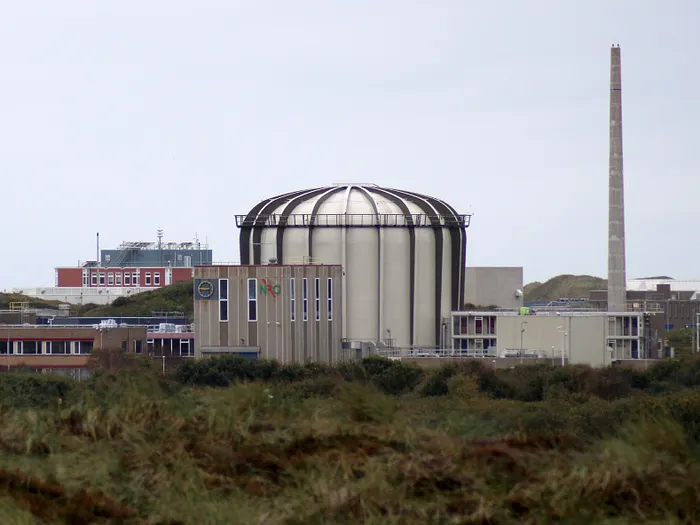

An hour up the coast from Amsterdam there is an object. The object consists of a variety of unassuming buildings, the most striking of which is a ribbed, squat cylinder.
The object is bounded on one side by a levee covered in tall grasses and a ramrod-straight highway. Beyond the highway perfectly flat and square Dutch fields stretch to the horizon, rows of crops arranged as though by a giant’s razor blade. Columns of wind turbines march across the landscape, hazy with distance.
The object is bounded on the other side by the North Sea. You can see the waves from within its fence if you stand in the right spot; the object is tucked into a rumpled strip of barrier land between the Netherlands and its oldest enemy. Despite this proximity, the object does not sit on reclaimed land. It is too important for that.
For as you have gone about your day you have depended upon the object. When you open your plastic bag of cereal and pour in milk from a carton you depend upon it. When you fill up your car you depend upon it. When you use the internet on a United Airlines flight you depend upon it. And at the end of it all, when you lie in your deathbed breathing oxygen through a mask: you still depend upon the object.
The object is the High Flux Reactor, and it is one of a few facilities in the world that produces Iridium-192 gamma ray sources. These sources are used to take images of welds to assess their quality. Ir-192 in particular is used for process pipework, particularly steel pipe less than 100mm thick.
Major collections of ‘process pipework’ can be found in the petroleum, chemical, medical, aerospace, and food industries. Processed food could be something as simple as frozen peas, which are typically snap frozen using liquid nitrogen. It’s hard to overemphasise the importance of process pipework to the functioning of modern society, and Ir-192 is key to its construction.
Ir-192 is used in this application because it releases gamma rays at just the right energy level for common sizes of steel pipe. Think about the exposure setting on a camera: if it’s too high or too low, the image washes out into white or black and details disappear. Minor details in how the steel varies are important, because the radiographic image needs to capture any voids that could structurally compromise the weld. You want to use a source with the lowest-energy rays you can get away with, since lower energy means better contrast (the rays are absorbed better by features) and more portable shielding equipment (low-energy rays are easy to block).
A small source is also desirable to cast sharp shadows; Ir-192 provides a high level of specific irradiation—a working source is a capsule the size of a fingernail. Avoiding uranium simplifies the supply chain for obvious reasons, and it also helps that Ir-192 is simple to make: just bombard iridium metal (most of which is mined in South Africa) with neutrons, creating Ir-192 from Ir-191 as neutron capture occurs. An Ir-192 source is completely passive, which is a benefit considering how much process pipework—for example, on pipelines—is in remote areas.
Finally, its half-life of 74 days strikes a good balance between radiative intensity and practicality. It’s not so long that you need a large, heavy source because such a small amount of decay is happening, or so short that you can only use a source for one or two inspections.
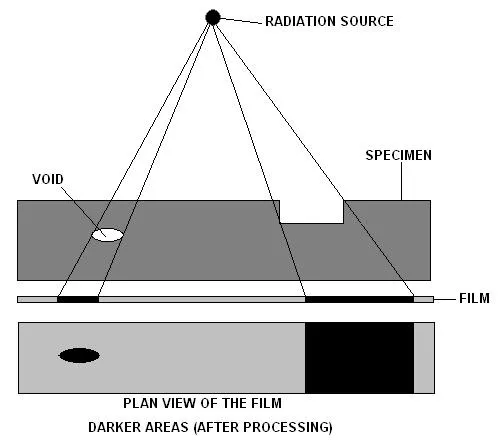
The Ir-192 source illuminates a digital absorber or photographic film as in the image above, creating a permanent image of the weld’s cross-section. Voids show up clearly as high-contrast dark areas. It’s easy to tell if a weld has achieved full penetration on butt welds to seal the gap between the two joined pieces of pipe.
This happens because the intensity of the radiation striking the film falls off exponentially with thickness; a 2mm void in a 12mm wall would result in an 11% increase in incident radiation. This means that impurities with a different density to the steel, like slag or debris from a welding electrode, show up clearly.
In practical terms: field teams drive out to the pipe to be inspected, set up the shot with film on one side of the weld and the source device on the other, set up portable shielding like lead-lined blankets to block off the test area, and then remotely expose the source for a brief period to take an image. Usually you will image from both directions perpendicular to the weld, only reading the wall nearest to you each time, but small-bore pipes can be imaged elliptically—the line between the source and film passes through the pipe at an angle, meaning the entire weld appears as a single ellipse.
Reading a weld radiograph is surprisingly easy—you’re basically looking for weird, irregular dark patterns. Medical radiology this is not.
The father of industrial radiography is a nearly forgotten fellow named Horace Lester, who used an electrically powered X-ray machine installed by the US Army to examine castings for a steam plant in 1924. It had taken 29 years for the practical implementation to follow Röntgen’s discovery of X-rays in 1895.
Gamma radiography was introduced in the 1930s; the enormous X-ray machines of the time were impractical for field work, to say the least, whereas low-tech radium gamma sources were passive emitters that required no infrastructure. The Second World War, with its vast quantities of welded ships and aircraft, entrenched the process as a standard part of manufacturing. It also successively gave rise to the Manhattan Project, nuclear reactors, and finally artificial isotopes like Ir-192, the usefulness of which was first recognised in 1953.
You can of course still weld pipes without doing radiographic inspection. This was the world of the 19th century; joints were overbuilt to account for flaws that could not be detected, and thousands of boiler explosions were tolerated across the US and Europe—each was a disaster that often caused multiple fatalities. However, subtracting radiographic inspection from our modern world would not simply return us to the past. The modern apparatus of engineering design (including ASME standards on pipework designs), regulatory certification, and insurance all depends on the assurance provided by non-destructive testing. We would need to redesign this entire apparatus, overbuild new infrastructure, and accept lower quality welding due to the lack of oversight. This would not be a trivial undertaking, and its effects would be felt in every sector of the material economy underpinning our society.
So, how fragile is the supply chain for these little irradiated discs? First of all, Ir-192 is important, but it is just a case study. Other isotopes are also used—like higher-energy cobalt-60 for thicker pipework—and non-radioactive methods are available like liquid penetrant testing.
It is true that very few reactors produce Ir-192 sources. Alongside the HFR in the Netherlands there is a Russian complex in Dimitrovgrad that is potentially still the main global supplier (!), another major European reactor in Belgium, the SAFARI-1 complex in South Africa,1 and most recently the DOE’s High Flux Isotope Reactor at Oak Ridge, which has a small slice but is significant due to the return of domestic US supply to the market.
Many critical commodities are like this, and it’s not always cause for alarm. Think of the two mines in North Carolina that produce the world’s supply of ultra-pure quartz for the semiconductor industry. People panic when these mines are threatened by fire or flood, but this is misguided: a spike in demand would cause new lodes to be prospected and exploited in short order.
But research reactors do not grow on trees, and sources decay within a matter of months. The lead time for a new facility would be significant even in a crisis, and so there is genuine vulnerability in the supply chain. Even brief unplanned shutdowns for these reactors or geopolitical complications like the invasion of Ukraine cause shortages.
Still, I wouldn’t start stocking up on canned food just yet. If nothing else changes, Ir-192 will likely be phased out over the coming decades by more compact electronic X-ray equipment. And in the meantime any disruptions will be felt but absorbed, their ripples attenuating before they become felt at the level of the consumer.
One dichotomy of our modern world that can be difficult to square is the simultaneous fragility and robustness of supply chains. In absolute terms there is very little margin for error; your life depends on a hundred different knife-juggling acts that cannot cease for an instant. But prod these systems and they will adapt, deform, and reroute. The human beings that compose them all have illegible Plan Bs and Plan Cs—kludges, relationships, slack that can be repurposed. The greatest gift you can give them is to set aside your worrying and get on with living well.
This guy has been running on fuel from SA’s nuclear weapons program since about 1970. Yes, it’s still running on the flesh of the decommissioned bombs!
↩