The Trials of Eunuch Zacharias
"Zacharias, strategos, pit-slave, eunuch, and most favoured servant of the Emperor, ran for his life."
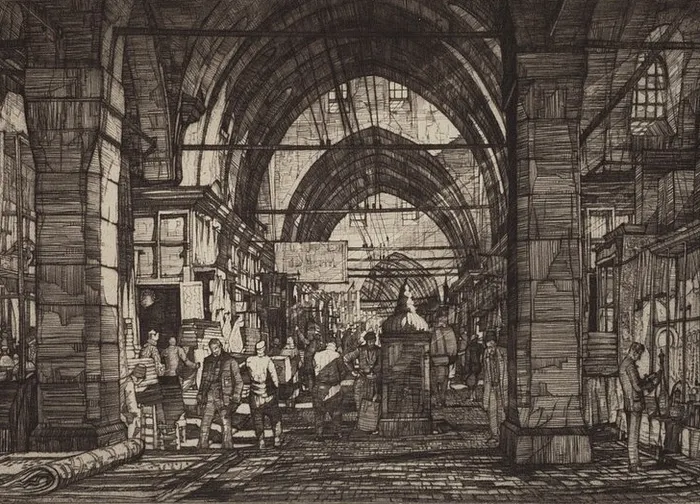
This story owes its existence to "What can LLMs Never Do?"
Zacharias, strategos, pit-slave, eunuch, and most favoured servant of the Emperor, ran for his life.
He had been on his way home, wending through the wealthy areas of the capital surrounding the imperial palace: squat, domed mansions set back from the street amongst gardens and dripping with arches, contrasted against narrow streets hemmed in by shops and apartments.
It had happened at the mouth of an alleyway between two such shops; a useful shortcut Zacharias used habitually, though it stank of piss and sulphur from the chemist’s rooms that opened onto it. He didn’t mind; he had seen worse.
A stocky young man had hailed him at the entrance, seemingly lost, his limbs lost in loose robes and a hood thrown back about his neck. He could have been any of the thousands of itinerant monks who passed through the capital at this time of year in search of education, a mission, or the hearing of a petition.
Strange to find another soul at this time of night, but Zacharias had been inclined to think well of him, given his own monk’s garb; had been, until a breeze jostled down the alleyway and lifted the man’s robes a little, revealing a short sword winking in the early moonlight.
They both froze for a moment, Zacharias in mid-stride, his opponent awkwardly clutching his blade.
“Damn,” the stranger swore, shrugging off the robe. The transformation was instant: what had been the image of a humble acolyte a moment before was now nothing more than a common thug, face hard, grip white on his pommel, striding forward in boots and a leather jerkin.
So that was that. Most men might have wondered why anyone might wish to send an assassin after them. But he had a few good ideas, Zacharias reflected as he scrambled down the alleyway, walls scraping his shoulders.
Now, Zacharias was no spring chicken. In his prime as the Emperor’s foremost strategos he would have been able to cut this whoreson down without breaking a sweat, but as with all else, the slave pits had taken their toll.
Well, more likely his recent months of scholarship had: but regardless, Zacharias was puffing before he’d even reached the end of the alley, and would have been dead to rights had it not been for Fate’s timely intervention.
Behind him he heard a commotion as a servant leaving one of the shops for the night opened a door directly into the face of Zacharias’s pursuer. Emitting a string of foul curses, the assassin wasted no time: the poor servingman was cut down mid-apology. But evidently he was not alone. Within moments a kitchen bell was tolling the alarm, and Zacharias glanced over his shoulder to see his pursuer emerge from the alleyway, closely followed by a hollering group wielding wicked-looking kitchen instruments.
But this did little to improve his prospects. The mercenary on his tail seemed determined to see his mission through regardless. Zacharias continued down the avenue until, casting about, he noticed a particularly appealing wall.
The avenue he found himself on was fronted by estates that were set back from the street behind high walls. Most of these were solid brick or stone, offering no purchase to an aspiring thief; but here was a manse whose owner could not resist the allure of decoration. Its wall was wrought iron and solid granite, carved into fanciful spirals and waves, with segments of lattice that provided glimpses of the garden beyond. Beautiful; but more importantly, rich with footholds.
His arms trembled as he hauled himself up, and he scraped long strips of the skin on his legs raw against the uneven granite. By the time he went tumbling over the top the pounding of the assassin’s feet (and the constant string of low curses that came with it) was uncomfortably close.
But he’d made it. And for a moment Zacharias thought he had signed his own death warrant, for the garden was tightly enclosed on all sides. There came a scrambling from the street, the mercenary’s feet rasping against the stone of the wall. But just as Zacharias was backing up across a bed of hyacinths and preparing to make his peace with the Creator, this was cut off abruptly. The kitchen staff had torn the assassin from his perch and wasted no time in exacting their vengeance.
Thus delivered, Zacharias collapsed on a nearby bench, his chest heaving and his throat feeling as though it had been scoured with sand. But this was not to last long. He faintly noted the crunch of gravel on the path behind him, and was in the process of half-turning when a club sent him sprawling into dreamless sleep.
TWO YEARS EARLIER
He returned to court in rags.
It was just as well that old Karas had been posted to the western border. By the time imperial forces had finally crushed the barbarians in the field, retaken Skythopolis, and thrown open the doors to its improvised slave-pits, he was all but unrecognisable. Lighter by fifty litra and a manhood, wasted and trudging along amongst his liberated peers.
But he’d fought alongside Karas as a fellow strategos for a dozen years before his capture. It only took a moment for the old man to meet his gaze from atop his mount, and another for a few akritai to muscle their way through the wretched press and drag him out to stand marinating in the sun like a rotten pickle.
And now here he was. The Emperor rose in his seat as he tramped into the throne room, alone, and knelt upon the carpet.
“Zacharias!”
At the sound of his name issuing from those lips, so familiar and yet now so alien, Zacharias looked up to meet the gaze of his liege.
“Zacharias, how I have missed you these long years! How I have searched for you! Yet now, finally, Fate returns you to me. A lesson, perhaps. Many have held your post, but none with your loyalty, your vigour, your strength, or your courage.”
“A cruel lesson.” And the court shared meaningful glances at the hoarseness that now marred Zacharias’ voice. He continued: “My time amongst the barbarians has left me… diminished. In more ways than one. All I have left to offer you is my loyalty.”
“And that is more than enough, my friend. More than enough. Yet why do you appear before us in the guise of a common man?”
“So that I may present myself honestly. I can assure you I was offered robes of office, but they no longer suit me. My only wish is to serve you, kyrios, but I do not know what services remain mine to offer.”
At this the emperor quirked his head in that familiar way of his as he sat back on the throne, like a sparrow caught between caution and hunger. He paused to consider for a moment before speaking.
“I see your mind remains as sharp as ever. Tell me, have you retained your command of the aftokratorikí glóssa?”
So it was that Zacharias found himself freshly bathed, clad in the simple shift of a monk and at liberty in the Imperial Library the following morning.
Ah, the Library! The great structure was some three centuries old now, mellowing out into matronly middle age, its bricks baked yellow and wrinkled in the sun like preserved fruit. Its interior was dominated by one huge open space, capped by a dome which was ringed at its base by vaulted windows, its concavity illuminated both by the morning light and the touch of a long-dead master. Angels, saints, and philosophers of old cavorted together down the silent years.
They looked into a thicket of terraces, a sibilance of shelves, ladders and stools and stairs scattered like the strands of a web. But there were no cobwebs here; no dust; no vermin made their home in the Library. The stairs and ladders were worn smooth and bright, parabolic divots carved by generations of monks ambulating back and forth down the aisles. Inspecting, cataloguing, cleaning, but never reading.
Yes, never reading. For this was a Library incomprehensible to the empire that had built it. Its books were gibberish to the merchants who hawked pungent fish in the streets below, to the workmen who had laid its bricks, even to the scribes that had filled its volumes. Its doors were never barred yet the Library was eternally secured by that most complex lock of all: the aftokratorikí glóssa, the Imperial Tongue.
Zacharias’ grasp of it was rusty but certainly serviceable. That was more than could be said for almost any other man: half code, half language, the Tongue had been devised by the infamously paranoid Photius II. Since then it had passed down the imperial lineage and to a select few others, unique to the vast library Photius had spent his life assembling.
Needless to say, Zacharias had been one of those select few. He remembered the day well. The smell of olive tree blossoms and the taste of iron had been in the air as a summer storm brewed. He’d been drinking in the sun on the terrace, a moment of solitude after the chaos of another campaign. It amused him now to recall his fury at being interrupted by an aide, and the man’s hasty apologies for bringing him the greatest honour a subject of the emperor could hope to receive.
How petty he had been. How those memories had strengthened, too, since he had returned to the capital. Amongst the slave-pits of the barbarians, reduced to little more than a beast, they had belonged to another man from another time. Yet so little had changed in the capital that it was as though time’s arrow had flown backwards during the long sweat-dream that had been his time in the pits.
But one thing had: Libanius - the emperor’s brother - had succumbed to cholera two years previously, meaning that he was the only one in the city besides the emperor and his young children (bless them) with the gift of the aftokratorikí glóssa. With his liege occupied by day-to-day business, Zacharias had found his calling. Gingerly he approached the first of the shelves before him, levered out a few volumes, and set to work.
Spring became summer and summer yielded to autumn as Zacharias trickled his way through the classical histories and the agricultural treatises. He lived a life of simple luxury. Plain fare was ambrosia against years of pliable rat meat that went down with the tang of bitter iron. He marvelled at the touch of his monk’s robes, and went to a soft cot at the end of each day. Greatest of all was the pleasure of serving his Emperor without paying any heed to petty politics. Tension gathered in his trapezii Zacharias had not even known he was carrying began to unwind.
Reality faded. But then one chilly autumn morning a functionary hailed him in one of the outer arcades, fog clinging low about the flanks of the palace and softening the bay below. Spray misted the air. Salt, fish guts and the excrement of gulls needled Zacharias’ nose.
“Kyrios,” said the pinched little man, “the emperor requests your attendance at court this afternoon. He wishes to hear what wisdom you have so far gleaned from your studies.”
“I am no lord, but tell my master I will attend him as he wishes.”
The Emperor drummed the fingers of one hand against the throne’s minutely carved arm.
“The material is to your satisfaction?”
“Of course, your eminence,” Zacharias replied. “All the great works are accounted for. Never have I seen an edition of On Labor so complete and well-preserved.”
At this there was some small stirring amongst the emperor’s other scholars, whom Zacharias noted were more finely ornamented than those he remembered from his days as a strategos.
“Excellent. Most excellent. Then might you answer a few questions on these matters?”
“It would be my honour.”
“Firstly: the seasons are sluggish this year, as you may have noted. Our farmers are struggling with these heavy fogs. Do you have any guidance on this matter?”
“Yes. Baradeus advises the planting of emmer rather than wheat in such times, as it is more resistant to damp. And if crops must be sown in dewy soil, then Melissenos proscribes the planting of millet and turnip alongside them. Particularly what he calls Lydian turnips, which we now know as the black northern turnip.”
“Lydian turnips. Most interesting.” There was not a trace of irony in the Emperor’s tone. Quills scratched and rustled in the shadows of the audience hall as scribes took this business down.
Several questions followed: on law, construction, the business of coinage. But the classical histories had been wide in their scope, and Zacharias rose to the occasion with well-referenced advice.
When it was over he emerged into a crisp and brilliant day, the noonday sun having burned the fog into scraps and driven it into corners like a struck cur. A smile broke across his features. It had been so long since he had smiled, he realized: not since that last night before his ill-fated border skirmish, sipping wine in his tent with poor Trytherus, who was now just mouldering bones. But oh, how it felt to be of service to one’s lord and people again, to have purpose!
A year passed easily in this fashion. The long summer days flowed into one another like honey, the library high and airy. Light was only admitted into the main chamber by the narrow windows set into the belt of the cupola far above; the intention was to preserve the merchandise, but this also made even the harshest daylight pleasantly diffuse. Dust and the scent of floor polish became familiar bedfellows in Zacharias’ nostrils.
He moved on through alchemy and into the taxonomy of animals. His meals remained simple, now because he paid little attention to what passed his lips. When Zacharias lay abed each night he felt the blankets in his hands like sheaves of parchment. He dreamed of shelves.
Each fortnight Zacharias was called before the Emperor, and each fortnight he answered easily and comprehensively, the words flowing easily: he was merely the mouth of a channel that twisted in subtle meanderings, its headwaters tenebrous in antiquity.
It was a happy age. Farmers, having sown their fields with black turnips after an imperial decree, had drawn a bumper crop despite the wet summer. The empire was flush with food while her neighbours starved. Not all of Zacharias’ commentary had borne such fruit, but much had proven useful in small ways, and the Emperor’s dominion was at peace. Alas, it was not to last.
The first Zacharias knew of this was in the winter of 862 as he hurried toward the library one morning along his well-worn path. Above, the sky hunkered low, iron-gray: it was a merciless day. He withdrew against the cold, the wind raising gooseflesh along his arms through the meagre protection of the robe.
The streets were thronged with a strangely taciturn sort. From officials to servants they all moved in the same manner: vacant and drawn, their faces mirrors reflecting the sky. So Zacharias found himself amongst kin that morning.
He found it odd, but paid it little mind. The greater part of his attention was occupied by the final volume of Principles of Celestial Observation. With that dispatched, he could bid his goodbyes to natural philosophy and begin to acquaint himself with the great generals of history.
Dispatch it Zacharias did, but when he entered the audience chamber that afternoon, he found it spartan, the usual crowd of nobles reduced to a scattered few, with armed guards sulking in the corners. The imperial jaw was set, the imperial lips a pursed white line.
A war. The eastern heathens had been raising a great host in secret, and had struck deep past the empire’s borders, pillaging as they went. The questions now were single-minded, blunt. What did he know of strategy? Tactics? Logistics? The raising of war-engines?
And then - “Tell me: how many servants should an army of ten thousand travel with on campaign? My southern lords are massing for the march, but I hear that the staff that gathers with them is prodigious indeed, some four or five thousand. My strategii worry at the cost of supporting such an assemblage.”
He did not know. He did not know. No doubt the answer was somewhere in the Library. But finally the Emperor’s curiosity had outstripped his scholarship. What to do?
Zacharias worried at the callused pads of his fingers with the edge of a nail. Small, desperate sounds of thought escaped his throat. His brow was creased severely in what felt like a mockery of seriousness.
The higher parts of his mind abdicated entirely, leaving an animal core squirming to escape. But it was decisive where Zacharias was not. He recovered just in time to deliver his lie smoothly.
“Kyrios, your worries are well-founded. Several learned sources recommend no more than one servant for each four soldiers. In your case two and a half thousand for a standing force of ten. Republican and old imperial alike considered anything greater than this a sign of poor discipline.”
Zacharias trusted the empire’s strategii, and knew it was what his master wished to hear. And indeed the Emperor nodded, considering.
“Poor discipline. Yes, those old fools will need to do without their wine and whores for these few months.” He looked around at the clerks attending the throne. “Have an envoy sent at once.”
When it was over Zacharias wandered the streets in a daze, eventually finding himself at the door to his rooms through no conscious effort. He collapsed through the door and onto the bed after sealing the room behind him; only then did he begin to return to the world. There had been no further questions - thank the Lord. He shivered with undissipated energy late into the night, half-expecting a bolt of lightning to strike him down at any moment, and half-disappointed when none materialised.
The next week he found a passage in Boilas’ The Matter of Warfare recommending four soldiers to a servant, and felt a great weight leave his shoulders. But there was little time to relax, for Zacharias was now elbow-deep in a summary of everything the archive had to say on waging war. Contradicting citations and unclear terms chased him through his sleeping and waking hours alike, his desk splattered with ink and candle wax. Zacharias had stopped smelling the tang of his own sweat and knew he looked a beggar in his stained robe, skirting the palace walls on his way to the library in the mornings.
But after more than a month it was finally complete. Its submission left him adrift - he spent two days confined to his quarters, convinced he could never open another book again - but eventually he roused himself to the palace baths. This turned out to be an excellent idea. The grime of the past several weeks sluiced easily into the pool; the steam caressed him with pleasant, rainbow-hued billows; and the heat dampened the phantom needling in his groin that was otherwise now his constant companion.
Zacharias reclined against the steps, half-submerged, and drew deep, satisfied breaths of the lavender-scented air. The arcades around this pool were open to the day beyond and thronged with a veritable pantheon of historical figures: indeed, many of the characters that Zacharias had just spent so long becoming acquainted with. If one squinted through the steam their marble fixity dissolved into motion, and it almost seemed that they had returned to life.
“Baradeus, you old fool,” said Zacharias under his breath as he focused on a particular sculpture, “you might have forgotten more than I’ll ever know about sowing fields, but I’ll bet you never had a bath like this.”
It was at that moment when the pinheaded palace servant who had first summoned Zacharias to the audience chamber found him once again.
After dressing with no small amount of private chagrin, he was led deep into the palace complex by an ornately armoured manglavitai, whip coiled at his hip. Zacharias deferred to the guard’s superfluous directions. The barbarians had taken much from him, but they had never managed to touch his manners.
The emperor’s rooms were just as he remembered them: richly panelled in dark wood, but furnished minimally in contrast with the palace around them. A delicate floral scent lingered in the air. He found the Emperor in his study: a tall, narrow room, with a window at one end providing views of the gardens below, and shelves sunk into the walls to either side. It was dominated by the Emperor’s desk, currently invested by a contravallation of nervous scholars and advisers. Most of these men Zacharias knew poorly; their appointments had been made during his absence. Guards lingered in the corners decoratively.
By way of greeting the emperor simply said, “Zacharias. How should one build the hull of a ship?”
“Your eminence. The planks of the outer hull should be cut to shape, before being joined using a locked mortise and tenon. But the frame of the ship should be constructed first, so that the hull may be shaped about it. This will speed the construction and aid the manufacture of the hull’s parts.”
“And how might you produce clear glass, rather than aqua?”
“Kyrios, antimony should be added to the mixture during forging.”
The emperor finally looked up and scanned the room severely. “You see? He has already surpassed all of you! Restrain your arrogance, and remember that even a lifetime of study cannot equal the aftokratorikí glóssa. Dismissed.”
There was a disturbance to one side amongst a knot of scholars. One shook his fellows free and stepped up to address the emperor: “How can you dismiss us when we have not been given the tools this Zacharias has? You arm us in bronze and berate us when we cannot match his good steel. This court could be the centre of the world if you would only allow --”
His spiel was cut short by the intervention of the guards; he writhed and spat in their grasp. The emperor regarded the scene coolly.
“Every few years I hear a complaint of this nature. Listen well, you who I have gathered here, for it does not please me to repeat this more than I must. Photius was not merely a scholar studying at another’s archive. He built our library, curated it, even contributed to it. A wiser man than any of you can claim; and my kin to boot. So do not be surprised that I defer to his judgement in this matter. The imperial tongue will remain the property of the throne and,” he nodded at Zacharias, “those few who prove themselves worthy of the honour.”
“But though your complaint is hardly original,” the emperor continued, his focus returning to the dissident (who had now become silent and sullen), “an example must still be made.” He nodded to the soldiers, who marched out into the hall beyond, dragging their burden between them. The other scholars followed in clumps.
Zacharias felt their eyes on him like drops of hot lead as they filed out. He made to follow, but halted at a gesture from his master. All the joy of his triumph had turned to ashes in his stomach, and he stood with eyes downcast, awaiting his fate. He had only ever wanted to serve, he reflected bitterly, but that was the way of life.
“Your treatise has made quite the impression on my strategii, Zacharias. Many changes are afoot. With luck and the Lord’s favour we may soon turn the tide.”
“I am glad to be of service,” he replied stiffly.
“Is that all, old friend?” The emperor’s voice softened, before hardening again. “Look at me.”
Zacharias obeyed.
“This is about the other scholars, is it not? What does that concern you? You are hardly ever at court, and do not know them.”
“Kyrios, it is the shape of the thing I dislike. I know what you do, and why you do it, but I remember such situations well from my days as a soldier. I have never known one to end well.”
“Ah, Zacharias, I have missed your honesty. I wish I could similarly cure them of that sycophantic fawning! What use is an adviser that will never disagree with you, eh?”
He chuckled along with his master, but Zacharias thought of soldiers and servants then, and his stomach plunged further.
“Well. I apologise for subjecting you to that display. But you understand, your use cannot only be as a scholar! Anyhow. Do you grow close to mastering the archive?”
“Yes,” said Zacharias without hesitating, though in truth hundreds of books remained unopened. His mind was on the way the guards had carried the young scholar out - and how similar it was to how he had been dragged into the pits as a slave.
“Excellent. Well, I have some good news, for a change.” The emperor flashed him a weary smile. “Strategos Zeno has uncovered several vaults in Brandes and Kouras, built in the time of Photius and containing what seems to be hundreds of new volumes.”
Hundreds more volumes!
“That is fortuitous indeed, kyrios, yet I cannot help but harbour misgivings.”
“Speak,” said the Emperor impatiently.
“Is it wise to ship these tomes from their vaults to the palace,” ventured Zacharias, “particularly in time of war? It would seem Photius intended them to remain scattered, so that no single blow could destroy his work. You were exhorting the virtues of his judgement not moments ago.”
The emperor laughed. “So I was, Zacharias, so I was. Cunning as always. But I have considered this. The risk, I believe, is low: I need only leave the collection in your capable hands for a few months to identify the new texts and have them copied. Then they may return to their safe-houses.”
Zacharias bowed his head. “A most prudent course of judgement.” Oh, but why couldn’t you be a little more cautious? I’ve barely begun with marine taxonomy, let alone metalworking or medicine.
“That will be all. I look forward to your presence at court next week.”
So it was back to eyes swimming with tears from hours bathed in acrid candle-smoke, back to squinting at tiny letters, back to finding his way home by moonlight. Each page seemed to take twice as long as before. The longer Zacharias spent at his desk, the more easily words slipped from his mind.
The Imperial questions now came one after another at court, ranging across dozens of topics, happily wheeling from obscure history to natural philosophy and thence to cuisine. And just when he was beginning to - well, not get on top of this mad new state of affairs, but acclimatise somewhat, the baggage train from the East arrived.
Strategos Zeno had not exaggerated. Zacharias found his sanctum invaded by oxen and fresh-faced servants with dirt under their nails who called him ‘m’lord’. He was rapidly educated as to why Photius had constructed such vast doors to the central library: wagon after wagon plodded through to divest its precious cargo. The whole operation took two days. And after that it was straight back to his studies, his back feeling like a quarried boulder being broken up for shipping, his fingers cramping and twitching.
Under such circumstances, was it any wonder he began to give into weakness? He began to dabble in small fabrications that all replicated when he hunted down an answer feverishly the following evening. He was never more animated in his work than when looking for one of these sources: it was his own private confessional.
All in all, he was perpetually exhausted and distracted. So on one damp spring evening when Zacharias was on his way home he did not notice a figure leaning against a wall as they marked his passage through the marketplace beyond the palace.
Nor did he notice when that figure stirred like a shadow detaching from its owner and joined the crowds thronging the streets. He never glanced back to see them, hood thrown over their features, slipping deftly between stalls, oxen and haggling clumps of men.
Zacharias’ stomach rumbled at the smell of pastry and sizzling fat from the market behind him. He hurried on his way, turning onto a side street; and found himself, several minutes later, running for his life. And several minutes after that, having just escaped the catspaw of what was no doubt a jealous rival in the Imperial service, Zacharias was sprawled insensate across that gravel path, an innocuous detail amongst the riot of colour that was the garden around him.
Zacharias returned to the world as he had entered it: witless and struggling. For a confused moment after awakening, he thought he’d been transmuted by some strange force into one of the archive’s books. He could not move, or could not feel himself moving; but his mouth felt as though it were made of parchment, and his head heavy as one of the larger tomes on natural history.
But then his vision swam back into clarity, and feeling returned. Zacharias soon wished he had been turned into a book (which having no flesh and blood, could surely not feel pain).
And a book, whose mortal enemy was moisture, would not be afflicted by this evil thirst, Zacharias thought. Though perhaps it would, and all the pages of the library were locked in immortal torture, their only hope a catastrophic fire or infestation of moths.
But things were not so dire. Having levered himself upright (requiring several pauses, particularly at the zenith), Zacharias found a pitcher placed most considerately at his bedside, and drank deep.
Once these immediate needs were attended to he was able to get his bearings. His cell - it was obviously a cell - was a square of rough stone, a slit of a window mounted high on one wall. The air tasted of quicklime. His cot, of equally rough wood, was the only furniture. Gingerly Zacharias explored the back of his head with a few fingers, finding a basin of traumatised flesh which sent drumbeats of pain reverberating through his skull, but nothing broken. That was a relief, at least.
With this small universe mapped, he was left with nothing to do. But not for long. Perhaps an hour or so later, before the shaft of light slanting in through the window had begun to lengthen, the door thunked open, revealing a burly, bald and bearded creature in a servant's tunic.
“You’re awake,” he grunted, “good.”
“Um,” began Zacharias, “I assure you, sir, that you are labouring under a misunderstanding -- that I can explain myself completely if you give me a moment -- that I am, in fact, one of the foremost servants of the Emperor (blessed be hi--”
“You all say that,” said the servant, who had ignored Zacharias’ monologue, strode over, and now grabbed him by the collar. “Don’t change the fact m’lord is none too fond of trespassers.”
“No, please, just--”
He continued heedless, dragging Zacharias bodily out into the corridor as he scrambled to get his feet under him: “And you’re a lucky one. M’lord - that will be Patrikios Commendus to you, ‘Honoured Patrikios’ if your wits weren’t too scrambled by my tickle, ha ha - m’lord’s just returned home, and asked to see you.”
“Is - is he merciful?” asked Zacharias, who was keen to take his chances with just about anyone else.
“He’s fond o’ the lash, m’lord is,” mused his captor as they began to ascend a stairway, Zacharias stumbling along, having finally found his feet. “Mighty fond, in the case of bur-gu-lars.” (He relished each syllable of ‘burglars’ with great satisfaction). “Once I saw one suffer forty, he were recovering with us for a month. And then straight off to the courts, ha ha!”
Zacharias was beginning to feel that he did not quite share this sense of humour. But presently they came into a sitting room, candelabra burning softly and sweetly in alcoves, drapes softening the walls and the floor strewn with plush furniture. Seated at the centre as though arranged was a figure that could only be Commendus.
He was plump in that self-satisfied way of senior bureaucrats, enough to signal his wealth without sliding into corpulence. His hair had retreated to a shadow about his temples. But his face remained lean, his jaw sharp and birdlike. Prominent brows glowered over eyes that betrayed a deep, canny intelligence - the irises brown, seeming to swirl viscously like treacle in languid gyres.
“Care to explain what you were doing in my garden?” he said softly.
Zacharias swallowed. “Taking refuge from an assassin, Honoured Patrikios.” (This elicited a furtive, approving smile from the retainer, who had taken up a position to the side.)
Commendus leaned forward. “That’s certainly a new one. Go on.”
As best he could, Zacharias related the whole tale, beginning with his capture out on the frontier. He tried to strike a balance between believable detail and brevity, but Commendus remained rapt throughout, his chin resting on one fist.
When he finally petered out with a lame, “..and that’s how I find myself here before you,” the Patrikos simply nodded, as though this was something he encountered often.
“Well. Either you are telling the truth, or you are a remarkably talented storyteller. However, I’d wager there are far more men in this city with a silver tongue than an Imperial one. So you will remain my guest for the foreseeable future, I’m afraid.”
“Please, Patrikios, I can prove it to you, even with only a page of the aftokratorikí glóssa!”
Commendus boomed with laughter at that. “And how should I verify such a feat of translation?” Zacharias flushed. “No,” continued his captor, “but I am often at court. I have never seen you there, but surely our benevolent Emperor would recognize you immediately. We could visit next week?”
Zacharias fell to his knees, hands clasped before him. “Yes! Most honoured Patrikios, I beseech you - bring me before the Emperor, and I will be known at once. I have no doubt you will be richly rewarded.”
“Hmm.” The Patrikios narrowed his eyes. “A risky bluff. If you are bluffing… perhaps there is more to you than I first thought, Zacharias.”
Commendus snapped his fingers and at once abandoned his thoughtful aspect, all motion, sweeping up off the couch and toward the door.
“Should you be who you say you are, I have the use of the Emperor’s foremost advisor for the week. Solomon, return him to his room. Tomorrow we shall see how much he really knows.”
“Solomon,” Zacharias asked as he was frog-marched back down the basement corridor, “why so cheery?” For the manservant was whistling tunelessly. “I wasn’t even given one lash.”
“Ha-ha! Very good, eunuch. You amuse my master. I’m glad I swept you up,” replied Solomon easily.
And with that he was thrown unceremoniously back into the cell, the bolt thunking home behind him.
Commendus was as good as his word. Early the next day Zacharias found himself seated in the same room across from the Patrikios, this time at a low table stacked with papers and all manner of queer objects.
His jailer steepled his hands as soon as Zacharias had taken his seat. “Let us begin with the histories… in what year did the reign of Cydones the First end?”
The questions could at first have been answered by any monastic adept, and Zacharias breezed through them; but then Commendus began to dive into minutiae, flickering from one subject to another at random, referring to pages of the notes before him. None of this was knowledge exclusive to the Imperial library. And then after ten minutes: “Tzipoureles is known to have said that Xerus II was a "renewal, as it were, in his own person…”. A renewal of what?”
This Zacharias did not know. He remembered several similar quotes, and was fairly certain the original source would be the Panegyric of Xerus, but the words eluded him. But by now the habit of ‘filling in the gaps’, as he thought of it, was well embedded.
So he said, “‘...of the Empire and all her fortunes, particularly in the West.”
Commendus leaned forward, a gleam in his eye. “Finally I’ve got you, Zacharias! No, Xerus was a ‘renewal… of his father's life and reign’. But it is clear you are no charlatan. So let us see if this Library has managed to impart you wisdom as well as knowledge.”
Zacharias flushed, scratched at his neck, and braced for more questioning. But instead Commendus produced a stack of clay tablets, inlaid with attractive patterns of tiles. Each one showed an arrangement of fish, swirling against a dappled aquatic background. He laid two flat on the table.
“Study these: notice the pattern?”
Having seen nothing like this before, he did not, though Zacharias recalled some lines of verse from the second century regarding the procession of fish. They spoke of them travelling ‘with the sun’, i.e. from East to West. So did the fish in these plates: he ventured this theory.
Commendus stared at him strangely for a moment before shaking his head vehemently. “No, you’re overthinking it. See the lighter water tiles? It shows where the fish will move to in the next plate.”
“Of course, Patrikios,” replied Zacharias, feeling very foolish now that the answer was laid bare.
“This pattern will be different, but a similar problem,” said Commendus, producing a second set of plates. “Tell me the solution.”
Zacharias studied the pattern of greys, light blues and dark blues intently. One plate showed a veritable school of fish, while the other was almost entirely water. He had forgotten all about lashes and courts. After several minutes he asked, “Is the second plate a section of deeper ocean, below the first?”
For he had been reading treatises on the structure of the ocean before his capture, and several sources asserted that its deeper regions were less densely populated.
“No,” said Commendus again with some disappointment, “You see, only the fish that are overlapped by others in the first plate are reproduced in the second.” He scratched his beard thoughtfully. “Well, that is interesting. How about a riddle?”
Zacharias swallowed, but nodded.
“Tell me,” Commendus began in the lilting tones of a storyteller, “I set off from where we are now, and walk south for two dozen days and nights, stopping only to sleep. When I set up camp for the night on the twenty-fourth day, I go to fetch water and return to find a feline eating my supplies. What is this creature?”
“Ah,” said Zacharias after thinking for a moment, “that must be a caracal. In twenty-four days you would have made your way into the southern deserts it inhabits below our sea.”
Commendus nodded, once again seeming surprised. “Just so.” He glanced over his notes, and out at the sun just beginning to peek through the room’s curtains. “Very well. We will continue this tomorrow, but you have impressed me thus far, Zacharias. Or perhaps it would be more accurate to say you have interested me.”
And with a small smile he gestured for Zacharias to be returned to his cell. Zacharias lay awake uneasily that night, turning the questions over in his mind and wondering at their purpose. There had been a directness to what the Emperor had asked him; a clear link from answer to policy to public benefit that the long-dormant soldier in him had appreciated. But these? What could the Patrikios hope to gain from it? Not for the first time he wondered if he should be divulging even these small tokens from the Library to - well, a favoured servant of the Emperor no less, but one without the Tongue.
But when he imagined the Emperor standing before him the advice was always the same: Do not endanger yourself, Zacharias. You are too valuable. Play along with these games and soon you shall be returned to me unharmed.
The next morning Commendus picked up right where they had left off. To begin with there was another barrage of seemingly random questions. They were more obscure, but the answers still came easily to Zacharias’ lips as he flickered back and forth through his mental model of the Library. That is, they did until the Patrikios asked:
“Who was the first king to master the use of chariot archers in warfare?”
Simple! He was certain he had seen that information before. Yet as he searched the archive within his mind he only became more and more confused. If he thought about it, the source must be Warlords of the Delta, likely the second volume. But no matter how many times he went over its contents, nothing revealed itself. It was as though he could see the space where the answer lay, but it had been stripped bare. At a loss, he trusted his intuition.
“Khafra the Second?”
Commendus just looked at him inscrutably and asked, “What innovation is Amunheru the Third chiefly remembered for?”
This time the answer was clear and Zacharias answered confidently, “The eight-spoked chariot with mounted archers, of course.”
“Wrong on both counts,” said Commendus sadly, “the eight-spoked chariot was the work of Hatshepsut the First, unless the Library has some more enlightened source.”
At once Zacharias remembered: the phrase from Warlords of the Delta was ‘Hatshepsut I mastered the eight-spoked chariot…’. Yet his memory had only become clear with Commendus’ rephrasing of the statement. Now that he thought about it, this pattern mirrored several of the times he had been forced to lie to his Emperor, and all at once something about the Patrikios disquieted him immensely.
“Let’s try something else, Zacharias. Where does the lost capital of the Pathlians lie?”
This was something the Emperor had never asked him - something that no one knew for certain. It was hardly fair to expect him to untangle one of history’s great mysteries with nothing but his wits, Zacharias thought, but he considered it all the same. And when he did something began to take shape. There was a great quantity of scholarship concerning the Pathlians, for they had been one of the first great empires in the East, and hence much speculation about what Commendus asked. Now Zacharias considered the full corpus in a way he never had before. Though it strained his capabilities to their limits, he closed his eyes and gathered all the information the Library had to offer on the matter into one bundle. From that, clear patterns emerged:
“Well… As you know, there is no definitive answer to the matter, but the town of Kuthalon is the strongest candidate. Though most sources tend to support Romaios’s assertion that it lay ‘north of the rivers’, the evidence in Chronicles of the Ancients is much stronger. I also believe Kuthalon is a more sensible choice given that the city would have been governing the ‘land between the rivers’, as the Pathlians named their empire.”
Commendus’s eyebrows rose. “I received word today that the digging of a levee outside Kuthalon has uncovered ruins thought to be those of that very capital. I see no way you could have known. Most impressive.”
“Here,” he continued, producing a marked sheet of parchment and a pen. “I will leave you with this. Give me your solution tomorrow morning.”
When Solomon had cheerily deposited Zacharias back in his cell, he found that the sheet he had been provided with was - yet again - something completely new.
What follows is a type of puzzle once popular in the classical Empire, it read. Each box in the grid below should be filled in with a single number. When complete, each row and column, as well as each three-by-three sub-grid, should contain each of the numbers one to nine. The numbers that have already been entered cannot be moved or changed. Good luck.
And below that was indeed a nine-by-nine grid speckled with numbers. Zacharias leaned back on his cot, the wall leaching heat from his back, faint but pungent smells wafting in from the garden outside. He had seen a few references to these puzzles before, but never an actual example. Where to begin?
Once again he would have to trust his intuition. Marshalling all he knew about number grids, Zacharias strained to imagine how a master might fill out the puzzle and picked up his pen.
“This is nonsense,” scoffed Commendus the next morning. “I ought to have you whipped for such idiocy. Is this intentional? I have been nothing but gracious to you, Zacharias.”
“No, Honoured Patrikios,” he replied desperately, “I have given you my best.”
“Absurd! Look at the third row. You’ve placed two threes next to each other! How have you read the entire Photian archive without gaining one iota of wisdom?”
Zacharias examined the puzzle again, and now that Commendus mentioned it, his error was indeed obvious. “Did I make any other mistakes, Kyrios?”
Commendus stared at him open-mouthed for a moment before recovering. “It would be easier to list what you did right. But let us forget this. Clearly it is beyond you.” He shuffled the notes before him before fixing Zacharias with his gaze. “You have proven capable when it comes to matters of trivia, no matter the subject. But your reasoning seems to have been left wanting in certain ways.”
“Kyrios, I can give you any passage you desire from a dozen seminal works on mathematics and logic --”
The Patrikios silenced him with a gesture. “Yes, we have already established that. But tell me: what is four added to three, and then multiplied by five?”
Zacharias considered it; he was sure he’d seen dozens of these problems in Eudaemon’s Mathematica.
“Thirty and five?” Zacharias ventured.
Commendus nodded, and stroked his beard for a moment. “In certain ways, but not in others…” he muttered to himself, “is all of this mere regurgitation, or is there something more…”
He blinked and looked back up at Zacharias. “Look at this,” Commendus said, sliding a sheet of parchment across the table. It was a table of figures - hieroglyphic symbols like those used by the ancient kingdoms of the Delta. There were twelve rows: on each row two symbols were placed next to each other in a certain order, and across from these two was a third symbol. Zacharias considered the first row. A man, then a chariot, with the third symbol being a simple depiction of a mounted chariot and rider.
“Do you see?” asked Commendus. “What does each row mean, Zacharias?”
“It seems like the third symbol is a product of the other two, related to both of them in some way.”
“Indeed. Very good, in fact. Now consider this.” And he removed the reference table, replacing it with a string of some two dozen hieroglyphics.
“Simplify this for me down to a dozen symbols, according to the table you have just seen.”
Another task with no obvious purpose, thought Zacharias, but he bent to work all the same. He stared at the sequence for several minutes, turning the problem over in his mind, searching his mental archive for similar problems and finding nothing. So what would the finished sequence look like?
After another minute of concentration he had it. But when he’d finished laboriously copying out this solution and passed it to Commendus, his captor scoffed.
“Again, Zacharias, do you mock me? Ridiculous.” He laid the parchment out flat and stabbed at a particular segment with one corpulent finger. “Tell me, how does a field and a scythe make a ship?”
“I’m sorry, Patrikios, I cannot explain. It just felt right.”
“Is that the limit of your reasoning?” Commendus said, pinching the bridge of his nose. “No. Let’s try this again. But this time, Zacharias, I want you to consider each pair of symbols one by one, rather than the sequence entire. Treat them as individual problems.”
“Yes, Kyrios.”
It was a strange request, but Zacharias found as he reevaluated the problem that it helped. He forced himself to put the wider context out of his mind and just reference each pair of symbols against the image of the table he remembered: and a process emerged, a set of regular steps he could cycle through. When he reached the end it came as a surprise.
Commendus glanced at the result and nodded. “Much better. Reflection was all it took, hmm? Zacharias, let me give you the best piece of advice I ever received at the Academy of Rhetoric. Think before you speak, because nobody is easier to lie to than yourself.”
“Thank you, Honoured Patrikios,” said Zacharias. “But the Emperor does not call upon me to reflect, only reproduce the forms of what has been set down by minds more formidable than my own. It’s not my place to second-guess their wisdom.”
“There is no such thing as an objective point of view. All such reproduction would benefit from reflection - in fact, it is essential.” An imploring note entered Commendus’s voice, unnatural from such exalted lips. “Zacharias, please try applying what I have taught you to your wider duties. Break down problems, think step by step, and ask yourself if your answers are correct before offering them to the world. I have no doubt you are what you say you are. Tomorrow court will be in session and I may return you safely to our exalted master. But please remember me, and remember that upon your tongue is balanced the fate of thousands.”
It was an alien way of thinking about his duties, but Zacharias nodded despite his doubts about Commendus’s odd interests. This was a Patrikios, after all - practically the mouth of the Emperor.
For his part the Patrikios leaned back against the divan, his brow creased. He studied Zacharias searchingly, as though trying to discern the shape of the surface beneath, the words of the Library.
“I have done what I can,” he muttered.
The moment passed; Commendus waved a hand and Zacharias was marched away for the last time.
“So you’re no liar after all,” remarked Solomon, taking him deeper into the manse. “Say, aren’t I part of this library now?”
“What do you mean?” replied Zacharias, his mind still turning over what Commendus had said.
“Sort of like I’m a book reading myself to you, isn’t it? Ha ha. And now I’m sitting up on the shelves with everybody else.”
They’d reached a door, and Solomon levered it open to reveal an opulent guest room. “Now,” the servant said, “don’t be bee-smir-ching m’lord’s carpets, or dirtying his sheets. Or…”
“Yes,” said Zacharias wearily, “the lash, et cetera, et cetera.”
Solomon smiled. “See? You do have me in there. Solomon Ferro, meeting the Emperor!” And with a chuckle he was gone.
Zacharias slumped onto the edge of the bed, feeling as though he’d been hollowed out. The pitcher by the bedside was filled with spiced wine up here, and he took a long draught of its acidic aroma, before filling a cup and draining it decisively.
The Emperor was overjoyed to see Zacharias again, so much so that he waved aside Commendus’ tale of “harbouring Zacharias until the danger of assassination had passed”. The court was thrown into turmoil - first at his appearance, and then at his tale.
“Rest assured,” said the Emperor, raking the audience with a glare, “those responsible will be found.”
And found they were. A few weeks later the Emperor summoned him to a courtyard, hemmed in by arcades on three sides and open to the markets before the palace. The stars were beginning to fade as Zacharias arrived, already knowing what he was about to see. Indeed, the gallows had already been erected; the smell of pine sap was in the air.
He watched the proceedings quietly. Zacharias did not move or speak, but his eyes followed the condemned men, their wild gazes flickering out of their faces, until they had stilled.
The Emperor said something jocular to him and he replied politely, forgetting his words as soon as they were said. He licked his lips. He stood there for a little while, watching taut rope sway in the breeze as the guards bustled about, as dawn spread like a flowering bruise and began to limn the bodies with a delicate glow.
Then he returned to the Library.
It took Zacharias some time to settle back into his old routine. He’d lost much of his fervour, and Commendus’s probing had affected him more than he liked to admit. Those questions chased him down through the hours; he often caught himself paused halfway down a page, ruminating on one problem or another.
A comprehensive search of the archive turned up little in the manner of these puzzles. But he still found time to produce similar hieroglyphic problems to the one the Patrikios had shown him, and to practise his step-by-step thinking.
Soon the questions resumed. Most he answered truthfully. Many, no doubt, were of great use to the Empire’s invisible masses. But it did not seem to matter. His lies were accepted just as readily; indeed even seemed to do some good sometimes, and Zacharias felt only a slight twinge of fear now when the Emperor’s interest meandered into unfamiliar lands.
And the gifts Commendus had given him proved fruitful. Several times Zacharias was able to apply the methods to a particularly complex problem. He realised, disquieted, that he would have otherwise happily and confidently offered up a falsehood. He began to wonder how much of his knowledge was similarly illusory, even to himself. Still the Emperor offered nothing but admiration.
By now the war was going well. It was only a matter of time until the eastern provinces were returned to the lordship of God’s steward, they said, and the court bustled with excited young faces. For the first time Zacharias realised that his time was passing; perhaps had already passed. He began to notice prickles of pain in his knees, his back. He lay awake for hours each night, the darkness close about him, thinking of schools of frozen fish.
Victory arrived with summer. A fortuitous coincidence: the celebrations overlapped with the normal festivities. The city was turned upside down; the wine flowed like water; monks cavorted in the streets with thieves. Zacharias was at his desk in the Library, watching a few motes of dust dancing in the morning light.
Just before noon the spindling functionary Zacharias was so familiar with visited him again. They found the Emperor surrounded by his inner circle. It was an open courtyard, packed with tables that in turn were packed with dishes, cups, pitchers, and riotous tablecloths. The tops of the arcades were hung with barding and banners. People and furniture were strewn everywhere. There was a great nervous bustling of noise, pierced now and then by a shout or a scream of laughter; Zacharias screwed up his nose at the stench of wine and sweat - and sharper, less savoury scents beneath it all.
The Emperor cut through the crowd toward them as soon as Zacharias entered. Up close he could see his lord was ruddy with drink, his purple sash slipping off one shoulder. His eyes burned feverishly.
He pulled Zacharias into a fierce, crushing hug that left him sticky. “If any man can be said to be the architect of our victory -- the architect of peace in the Empire,” (even while drunk, the Emperor managed to pronounce the capital E) “it must be you, Zacharias. It must be you.”
“Thank you, Kyrios,” he replied demurely, glancing about at the scene.
“Anything you wish for is yours. Anything.”
“You know my wishes,” Zacharias sighed, “to serve the Empire faithfully and effectively.”
“Well,” replied the Emperor conspiratorially, “well. I may be able to grant that, certainly I may be able to… There is something I have been discussing with my advisors. Did you know that the Emperors of the East are immortal? That they choose the dates of their death on their own terms, guided by the movement of the stars?”
“I did not, Kyrios,” said Zacharias sceptically, but the Emperor was undaunted.
“Yes, it’s true. So now -- so now I wonder if Photius, that devious little prune,” at this he quirked his head in that familiar way of his, “had the same secret squirrelled away in that archive of his. Do you think so?”
Zacharias stood there for a moment, staring at his liege. He thought in steps.
“Yes,” he said at last, “I recall a recipe for such an elixir.” And he did; though it was a single source, and found cheek-by-jowl with instructions for summoning demons. But such information did not belong in this merry atmosphere, with the Emperor so volatile. His duty was to serve. His duty was to relate the information contained within the Library as best he could.
“You do?” said the Emperor, open-mouthed. “Well, let us not tarry -- Cosmas! Fetch one of my alchemists, and tell him to bring his materials!”
So Zacharias watched as a hunchbacked creature was brought forth, a donkey following, hitched to a cart packed with bottles and jars. He watched as the mixture was prepared, as the ten measures of mercury were poured out and heated. He watched as the Emperor downed it in a gulp, several of his inner circle urging him on.
A week later he was ready. The Library had provided the directions for the preparation of the mixture. The turmoil and now mourning of the Empire had allowed him to work undisturbed. He would not give them the satisfaction - the satisfaction of the heated implements, the screams, pine sap drying in the market square before dawn. No doubt they were already on their way.
He considered the cup before him. It crouched on his desk, pregnant with terrible possibility. He had only ever wanted to serve - but that was the way of life. He took a deep breath, filled with the taste of parchment and ink, the wood of the shelves, the fresh summer morning, the fish in the markets outside.
The poison was bitter on his tongue.