Waiting for the hammer to fall
On the Beach (1957), Nevil Shute
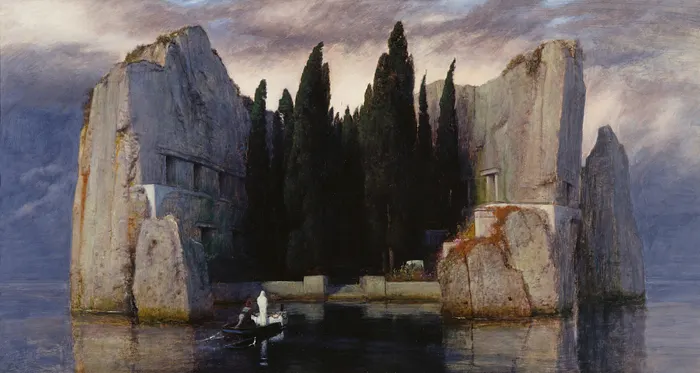
This nuclear novel is not about nukes.
There are no detonations in On the Beach (1957), no breathless newscasts, no burned and poisoned survivors. There is no nuclear war: by the time the book opens, it has already happened. Nobody knows much about how it started or how it was fought.
Instead this is a book about dying. The characters, all normal citizens of Melbourne, live out the last months of their lives as best they can as bands of radiation sweep southward to extinguish the human race. They live on the beach: that crack of light between two eternities of darkness, that threshold between life and death.
Obviously everyone is going to die someday, so you could say the condition of the cast is the same as ours. But distinctions matter: will you live long enough to see your son have a life of his own, or will he die in the cradle? Will there be anyone left to read the opus you scrawl out in your last few months?
The thing is, most nuclear novels are about what happens afterward - surviving, and building something new. For many people, though, there is no afterward. The only way to tell their stories besides “flash fiction”1 is to look at the time before, and so On the Beach is partly about living under the shadow of the bomb. It’s about you. The ICBMs are there whether you think about them or not.
Heroism is not the answer here. The plot of On the Beach is a thwarted heroes’ journey. There’s a call to adventure (a radio signal from the ruins of the United States), and our protagonist sets off with a plucky band of adventurers (the crew of a surviving US nuclear submarine) to cross the threshold and venture into the underworld (Seattle). But there is no ordeal and no reward: the radio signal is caused by the breeze, the world silent and dead. The descent into the underworld loses its stakes when the characters know that they’ll be heading back down the Styx in short order regardless of what they do.
So the scene where one of the crew goes ashore to investigate the radio signal is one of the most important in the novel. It’s the only time the narration really extends into the world destroyed by the bombs rather than peering at it from afar. We follow a crewman in a protective suit as he wanders ashore; he sees a single decomposed body. He finds the radio transmitter and matter-of-factly takes it off the air. He considers exploring more; he knows where he could find more bodies, but he has no desire to see them. Instead he picks up a newspaper edition that Australia was never delivered and reads a few installments of a serial (On the Beach was originally published as a newspaper serial).
Shute rejects nostalgia. There is no wallowing in despair, no pining after the world that was lost, but also no rubbernecking. There is no dead child clutching a copy of the Constitution with “NEVER AGAIN” daubed in blood on the wall above. Our character accepts what has been and moves on, knowing that the usual preoccupations of nuclear novels are a poor use of the little time he has left.
So what is the answer? What is a good use of time? What Shute lands on is an exhortation to struggle, the idea that when you strip everything away it’s still worth it to be productive for its own sake, to show up to work, to take classes, to put effort into your hobbies. The dignity of routine. One character trains as a typist; another restores a Ferrari. The closest thing On the Beach has to antagonists are those who reject this and sink into hedonism or anarchy.
This is all reinforced by the style. On the Beach was popular fiction in the 1950s and so likely seemed unremarkable then, but today the sparseness of the prose sticks out; like its characters this is not a novel that dwells. It’s pragmatic and straightforward. This isn’t to say it’s unsubtle or that its characters are cardboard cutouts - there’s real depth to them, but it stays below the surface for the most part. It’s a real contrast with, say, modern MFA stories. I found it refreshing.
One interesting thing this book does is spend a lot of time describing actions. Its characters aren’t ruminating, but they have to be doing something with their time on the page, and often they are simply acting. Take this passage, when our sailor is preparing to go ashore to find the radio transmitter:
The young man stubbed out his cigarette and stood while a couple of men adjusted the helmet and the harness of the pack. He tested the air, glanced at the pressure gauge, elevated one thumb, and climbed into the escape trunk, closing the door behind him.
Out on deck he stretched and breathed deeply, relishing the sunlight and the escape from the hull. Then he raised a hatch of the superstructure and pulled out the dinghy pack, stripped off the plastic sealing strips, unfolded the dinghy, and pressed the lever of the air bottle that inflated it. He tied the painter and lowered the rubber boat into the water, took the paddle and led the boat aft to the steps beside the conning tower. He clambered down into it, and pushed off from the submarine.
The boat was awkward to manoeuvre with the single paddle, and it took him ten minutes to reach the jetty. He made it fast and clambered up the ladder; as he began to walk towards the shore he heard one blast from the siren of the submarine. He turned and waved, and walked on.
This is superficially similar to the “TV prose” that Lincoln Michel discusses here, but in this context it works. There’s a distinction between a detached narrator describing each action like a screenplay or a court transcript and the moment-to-moment experience that Shute conveys here. One foot in front of the other: it’s the only way to avoid losing it. Several characters do throughout the course of On the Beach but we never see that process from the inside. Instead all we get are its external impressions - someone sitting in a corner and biting their nails, little disturbances like ripples on a pond.
Another undercurrent that’s important for On the Beach is the contrast between Australia and Britain. Shute moved to Australia in 1950 despite a successful engineering career in Britain (he worked on the R100 airship project, for example) after becoming fed up with the postwar socialist government. Shute wrote novels that addressed this much more directly earlier in the 1950s, but it’s still a key part of On the Beach.
In the novel, the northern hemisphere is literally dead, and this is spreading southward to smother Australia despite its dynamism and life. Australia is depicted as a land of pragmatism and industry; despite the impending doom, its society functions mostly as before, and ingenious solutions are found to keep things running. I can’t help but read Shute’s exhortations of labor for its own sake, of industry and ambition, as reprimands to the society he left behind in Britain. The flipside is that one of Shute’s flaws was always his engineer’s boneheaded pragmatism. Just work hard and stop complaining, guys, just install the technocracy and let the experts figure it out.
Another weak point of the book is its latent 1950s misogyny. The female characters could have been better; probably the biggest missed opportunity is the protagonist’s wife, left at home with a new baby and a garden to tend, who transitions from delusional to hysterical to meekly accepting. On the other hand, one of the highlights is a romance between the captain of the US submarine and an Australian woman, Moira. Captain Towers is dedicated to the family he left behind stateside and he only allows their connection to go so far; when pressed, he admits this is nonsensical, but he keeps himself going by looking forward to reuniting with his family in Heaven. This is not a one-sided dynamic, and the novel closes with Moira watching the submarine recede into the distance to be scuttled, imagining her life with Towers as she dies. Sure, On the Beach still fails the Bechtel test, but it could be worse.
Of course On the Beach is not an accurate depiction of nuclear war, and there will be some who survive even a full-scale conflict. I think in some ways it’s right - it’s probably more accurate to act like the world will end rather than expect some kind of recognisable society to survive - but we still might ask what the best nuclear novel that takes the perspective of survivors is.
I think this is A Canticle for Leibowitz, but that has had plenty of critical coverage elsewhere, so let’s talk about The Last Ship. This one is from 1988, but it’s superficially very similar to On the Beach: a full-scale exchange has made nearly the entire planet uninhabitable through radiation, and the crew of a naval ship goes on a heroes’ journey to find some hope of continuing life after the war.
There are a few things that set it apart. It has the precision of a Clancy techno-thriller, but is more reflective: a major part of the novel is the fact that the cast were actually part of the nuclear war, and the book opens with the mechanical process of their ship launching nuclear cruise missiles at a Soviet city. The guilt of participating has real consequences. They meet and cooperate with a Soviet nuclear submarine, and the tentative new world they end up founding in Antarctica at the end of the book is only made possible by the combination of these two cultures and vessels. It’s a great depiction of how naval commanders think and lead. It’s not going to blow your mind but it’s well constructed and even a little underrated2. It makes a nice contrast with On the Beach. It’s interesting how the introduction of a thread of hope in The Last Ship actually makes things harder for the characters; there is the chance that they can emerge from the other side of the underworld, but that’s exactly what makes it harrowing.
On the Beach was a huge hit in its day. Its relative sales numbers were comparable to Fourth Wing, and like the early romantasy successes it drove the growth of a genre. That comparison isn’t just me being trite. What does it say about what it was like to live through the early decades of the Cold War that something so bleak had such total sales dominance? Today the only thing that comes close is escapism.
The book was a terminal diagnosis for a whole society. Like most who receive such diagnoses, though, the people of the 1960s learned to live with it rather than change, to ignore it and delude themselves. Public anxiety about nuclear war had waned significantly by the late 1960s. And maybe that wasn’t such a bad strategy, since in hindsight it all worked out.
But there is that elusive clarity. I’m sure you’ve heard the stories of people whose diagnosis clarifies their perspective overnight; they’re suddenly and tragically able to focus on what matters. If only we could shock ourselves into that clarity without a real sword of Damocles hanging over us. In our latter age of distraction and imitation, people need it now more than ever.
And that, I think, is the enduring value of On the Beach.
An example: “At 12:52 pm on the 2nd of April, 1967, Janice Woodbury was in the process of alighting from the top step of the entrance to the Metropolitan Bank when she was instantly converted into a carbonised silhouette.”
↩Especially considering the TV series it was “adapted” into was terrible.
↩