Hard work in utopia
Terra Ignota's contributions to labor market discourse
These days utopias tend to be run by machines, for better or worse. The question is not what we will do with such a society, but what we will occupy ourselves with after handing the reins to our silicon descendants; our current conception of work disappears, since everything that needs to be done is handled without human input. This makes such utopias interesting - thinking about disempowerment is important! - but irrelevant to present conditions.
Terra Ignota is the opposite. Its world is still flawed1, yet it is far grander and more bizarre than ours, in the same way that Ada Palmer’s beloved enlightenment thinkers would consider the 21st century grander and more bizarre than the 18th.
This is a world still run by humans and hence one with work that must be done. And I think the attitude Palmer takes toward that work is very interesting despite its simplicity. We may not be able to build antimatter-powered flying cars, but we can take Terra Ignota’s utopian culture and apply it to the present if we can “just” solve the associated coordination problem.
Our first task is to work out how work works in Palmer’s works. The picture is pretty simple: everyone works twenty hours a week, which is treated more like a minor obligation, similar to doing one’s chores today. The exceptions are two minority populations. The first of these are ‘vokers’, aka vocateurs from ‘vocation’, people who have a calling and want to work at it as much as they can. Vokers work more than most people today; the books never give a single number, but the average seems around fifty to sixty hours a week2. There are also servicers. Terra Ignota still has prisons3 for ‘threatening’ criminals, but other convicts have the option of becoming a servicer, a system based on one of Thomas More’s thought experiments. Servicers are penal labourers that wander the world, made to wear uniforms and forbidden to own property, able to be engaged as a worker by any citizen. They technically aren’t slaves - they can always choose to go back to prison - but we see that they end up being assigned much of the tough or disgusting work remaining in the world of Terra Ignota.
People want different things
The first thing I appreciate here is the treatment of vokers. Terra Ignota strikes a balance where most science fiction lands on one of two extremes. Vokers are part of society but they are a minority and there isn’t a sense that society has somehow failed to turn everyone into a voker. This is part of Palmer’s masterful ability to inhabit and understand disparate moral-political positions; Terra Ignota is nearly unique as a truly pluralistic vision of the future.
An important part of Terra Ignota is that while vokers are a minority, they run the world. We also live in such a world, but the lack of an explicit cultural framework leads to some weird outcomes. The problem is that successful and influential cultural products are almost all created by vokers, so we have a society of 90% non-vokers being gaslit by a minority into thinking that there’s something wrong with them for not being a voker. Phrases like “follow your dreams” and “find your calling” help sort new vokers out of the rest of the population, with the collateral damage considered an acceptable sacrifice. Pop stars will often be candid about this in interviews: they aren’t speaking to you, but the one kid out of millions who might actually make it. You are probably not the target audience of the Jane Street recruitment ads in Dwarkesh episodes.
Now, I can already hear your furious objections brewing. To be clear, I think several things are true at once:
Vokers are a small minority of the population. Consider the obverse: that most people do not really have a ‘calling’.
Vokers are absolutely essential to the functioning of society, production of great art, etc.
Normal people enjoy their work more than they think or admit. Flow is real and usually achieved at work.
The system of gaslighting people into thinking of themselves as temporarily embarrassed vokers is extremely effective in some ways. It’s one of the reasons the US runs the world.
Messages like ‘follow your dreams’ are important for young vokers to hear, both personally and because of point 2.
Messages like ‘follow your dreams’ are actively harmful advice for non-vokers.
One place where this lack of awareness bites is in labor market discourse. Think about Redditors cheering on a strike at a Starbucks while New York fintech operators sneer at them on Twitter. Who is right in this situation? I think this is the wrong question.
Instead, here’s how I think about things:
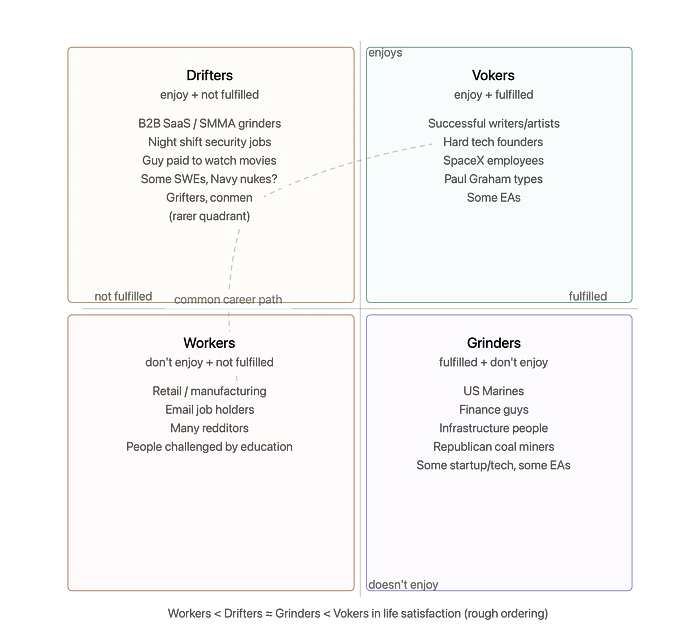
Feel free to quibble about the details, but hopefully the broad picture resonates. The issue is that often people are only vaguely aware of the quadrants outside their own, or if they are they don’t understand them. For my part, I have spent time as a Worker and a Drifter, I currently have a Grinder job, and the existence of this post should hopefully convince you I at least understand the Voker experience.
Returning to our union question, it’s true that the finance people are right that the empirical evidence is not great for modern unions. But it’s also true that unionising makes sense for the Starbucks Workers in a way it doesn’t for the fintech Vokers and Grinders; the former have a very different attitude to their work and live in a very different world in terms of how they are managed as employees.
Another good example is being fired. For a Worker, being fired is terrible - it’s usually not personal, and it often launches you into financial precarity. From that perspective, regulations to make layoffs harder make perfect sense. But a Grinder or a Voker might recognise firing as an important piece of feedback and a way to reallocate people to more productive work. They can tell you all about how one of the keys to American economic dynamism is making it easier for human capital to be moved from unproductive to productive firms.
It’s important to recognise that most people want a stable, comfy job where they can perform a well-defined set of tasks among a consistent set of peers they get along with. It’s also important to recognise that these types of institutions stifle the individuals who are driven to do the great work that moves society forward; instead, those people want exemptions to the usual rules, radical ownership, and the expectation of overcoming uncertainty.
The solution is not to demolish everything and replace it all with one type of institution. Redditors would like the former type and Twitter users would like the latter. Instead we need to acknowledge both preferences. Terra Ignota is one example of how this could look, and I think it’s quite an attractive vision.
It’s probably unrealistic to expect everyone to end up in the Voker quadrant, but I think good institutional design could move most people into a region where they are fulfilled by their work and at least don’t actively dislike it. At the same time, we can be more explicit about the reality of the voker phenomenon. We can reduce the unrealistic expectations put onto normal people. Just like in Terra Ignota, we can appreciate vokers for the contributions they make to society without lauding them as somehow morally superior to the average person; we can talk to them without feeling insecure that we have not yet found ‘our calling’ (which always seems one more self-help book or MOOC course away).
Work will set you free?
Then there are the servicers. Again, Palmer paints quite a rosy picture. But it’s a picture that brings darker visions to mind, and those visions call into question my earlier optimism.
The trouble with the servicer program is that, if you squint, it looks a lot like the gulags. The Soviet gulags were intended as a radically progressive program: the idea was that if you structured a judicial system around rehabilitation rather than punishment, then you should set your prisoners to productive work, through which they could discover the joys of being a useful member of society like one of those cats who bats away the treat before discovering how it tastes.
I just finished listening to The Gulag Archipelago, in which Solzhenitsyn recounts in exacting detail the ways in which this system mutated to create a living hell for millions of innocent people.
The distinction between the servicers and gulag is important for a few reasons. It helps to illustrate, in microcosm, the differences between dystopia and utopia; it also should help us calibrate our expectations for the cultural changes I just recommended in relation to the voker problem.
I think the clearest difference is the matter of coercion. The gulag prisoners had no alternative, whereas servicers always have the option of returning to prison. And you can see this play out in reality with the gulags: most prisoners looked forward to stays in squalid ‘transit prisons’ during transfers, because they offered a reprieve from the brutal work of the camps. Providing a form of exit limits the extent of abuse that can be levied against the prisoners. This is essential, not just from a moral perspective but also because prisoners are naturally denied the chance to exercise voice and loyalty.
Then we have scarcity and economic incentives. Another problem with the gulags was that they were too competitive with the real economy. The Soviets in the 1920s and 1930s were desperate for raw manpower and equally desperate for resources like food; the obvious solution was just to arrest people en masse as a form of labor conscription (the prisoner workers on projects like the White Sea Canal were referred to as a ‘canal army’). And because the economy was underdeveloped, the starving masses of prisoners weren’t outcompeted by firms with existing stocks of capital. You can see echoes of this in Herbert Hoover’s campagin against cheap prison labor competing with industry in the 1920s.
Separately, there were incentives to destroy the fulfilling aspects of the work to make prisoners easier to control, whether this took the form of pointless work, humiliation, or simple starvation. The camps’ secondary purpose as a liquidator for perceived enemies of the regime meant they needed to kill a certain number of prisoners to keep the population rotating; manpower acquisition was basically a political matter for camp administrators. The nature of the Soviet system produced graft at every level, which further immiserated the prisoners, and the lack of resources at the level of administration incentivised cooperation with criminals inside the system to maintain order and oppress those arrested for political offences.
My overall impression is that most of the evil in the gulag system followed naturally from material scarcity. Stalinism’s complex ideology was mostly irrelevant; what mattered was that it was willing to damage the material economy in service of that ideology, which incentivised brutality.
So this is the most important difference between the gulags and the servicers. Material abundance means that much of the labor the servicers do is interpersonal, and some fraction of the physical labor they engage in is basically make-work. Not completely pointless work such as the gulag prisoners were forced into, but something that could in theory be automated. It’s still useful for someone, which is the important part. The lack of scarcity reduces the demand-side pressure to create new servicers. Servicers themselves can be well-supplied with basic material comforts rather than effectively being tortured.
The supply of servicers is still small. We see that demand outstrips supply at several points throughout Terra Ignota, and some hints of servicer abuse, but institutions are functional enough and technology is good enough that supply does not expand beyond genuine criminals.
This makes me more confident in the earlier assessment of the voker issue, but it does highlight the care that needs to be taken when implementing utopian programs that involve any coercion at all. And coercion will have to exist somehow, at least in the medium term. There are things that people are not allowed to do to one another without consent. This is a claim about human society which I agree with Palmer on.
The servicer program is still one of the darkest spots of Terra Ignota, and Palmer frames it as such in the text. It is no coincidence that the series is told from the viewpoint of a servicer.
The danger of the incentives around initiatives like the servicer program makes me too wary to recommend it in anything like our current world. Unlike attitudes toward vokers, it’s too tied up in material conditions to be something that we can be confident lifting into the present. Unfortunately, many parts of Terra Ignota are like this, despite its unusual applicability to the present. One of the most frustrating things about utopia is how clear many of its aspects seem, while the necessary intermediate stages remain shrouded and murky.
The distinction is that the idea of ‘vokers’ is upstream of Palmer’s utopia, whereas the servicer program is downstream of it. Like many other aspects of the setting, it is an option enabled by the conditions rather than something that has helped to produce them. Still others, like the near-perfect safety of the transit network, are enabling work without shortcuts rather than mere cultural shifts. But the remaining subset of ideas is well worth considering.
I’m going to refer to the world as a ‘utopia’ here for the sake of concision, but I’m happy to grant that it doesn’t fully qualify.
↩These may seem like rookie numbers to some of you startup people, but hanging around the office browsing Twitter doesn’t count toward this tally.
↩Which we never see. Hmmm.
↩