Strike through the mask
The romance of Warhammer 40,000
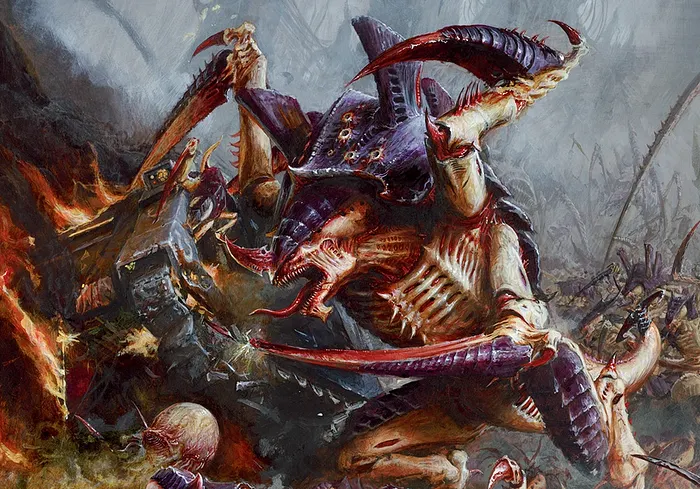
My adolescence was spent in a glorified parking lot. Christchurch, New Zealand is utterly flat and square. Every street is straight. Atmospheric currents force clouds into the Southern Alps to the west of the city, where they dump all their moisture. So the land is dry and desiccated, a Millennial (in both senses of the word) beige landscape of tussock. All the curbs are pristine. Christchurch’s dryness makes it the cleanest city I’ve ever been to.
There is a real city centre now, and there was one when I was born, but these share almost nothing. An earthquake demolished it when I was a kid; the city I grew up in was a loose agglomeration of suburbs and C-tier malls. The centre was a cauterised wound of empty lots. Even the earthquake was boring. I thought it was a passing truck at first and before it was even over I was looking forward to the time I’d have off school.
So there I was, growing up in the most Nothing Ever Happens suburb of the most NEH city in the most NEH country in the world, living under the most NEH political and economic conditions in human history. My father had an honest-to-God Flying Spaghetti Monster mug. I didn’t even have the solace of immigrant parents imbuing college admissions with existential stakes.
Now hold that image in your head. Imagine that one day you are visiting a mall; you’re young, full of the nervous yearning of puberty. You are wandering through shops you’ve seen a dozen times before. There is grey carpet and fake marble tiling and fake chrome trim. The stores sell kitchen implements, fishing gear, and cameras. There is a smell so pervasive you have stopped registering it as a smell and instead perceive it as a high-dimensional object skulking under the surface of your subconscious like a bony fish in a Cambrian ocean.
And then you see this:
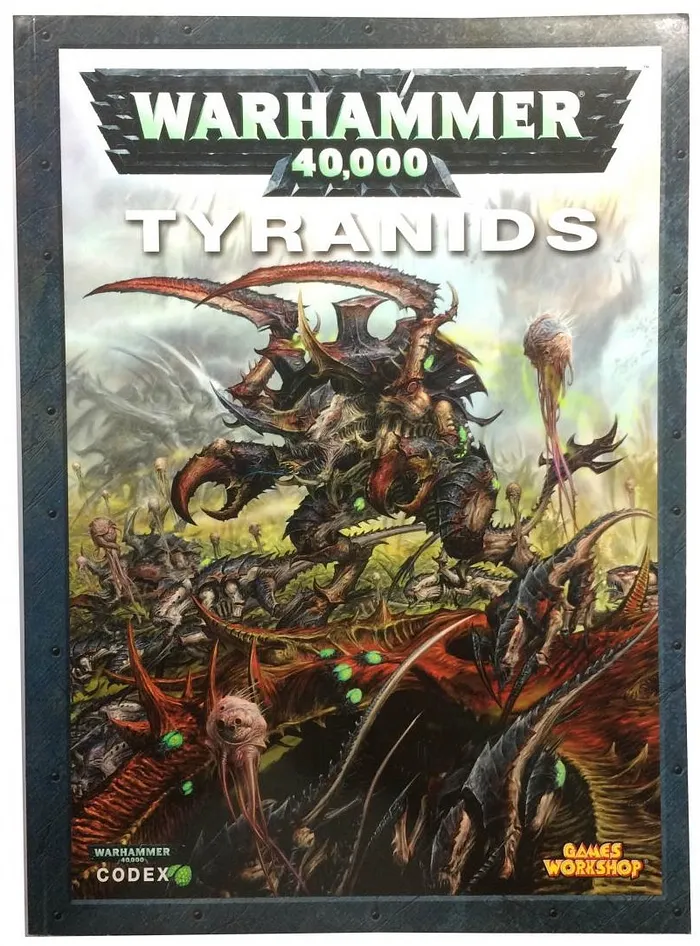
What is this? All this lurid detail, this sense of dynamism, the juxtaposition of the horrific and the majestic? And the half-glimpsed shapes in the distance, the fields of slavering aliens stretching to the horizon? Nothing is allowed to be like this. Nothing can be so unapologetically maximalist, so epic in scope, without some irony to undercut it.
You pick it up and open the first page.
Oh. They are serious: more serious than you thought possible, so serious that it just barely avoids shading into irony; but the atmosphere is so thick, every page bursting with detail, that you want to believe. Because on the other side of that veil of belief awaits vista after vista. Orgies of carnage so apocalyptic that they turn the sky black with upraised swords shining above the mêlée. Men and women standing alone against the darkness beneath heraldic banners handed down through millennia. Edifices dripping with gothic detail carved by desperate serfs. The weight of ritual hung around every action.
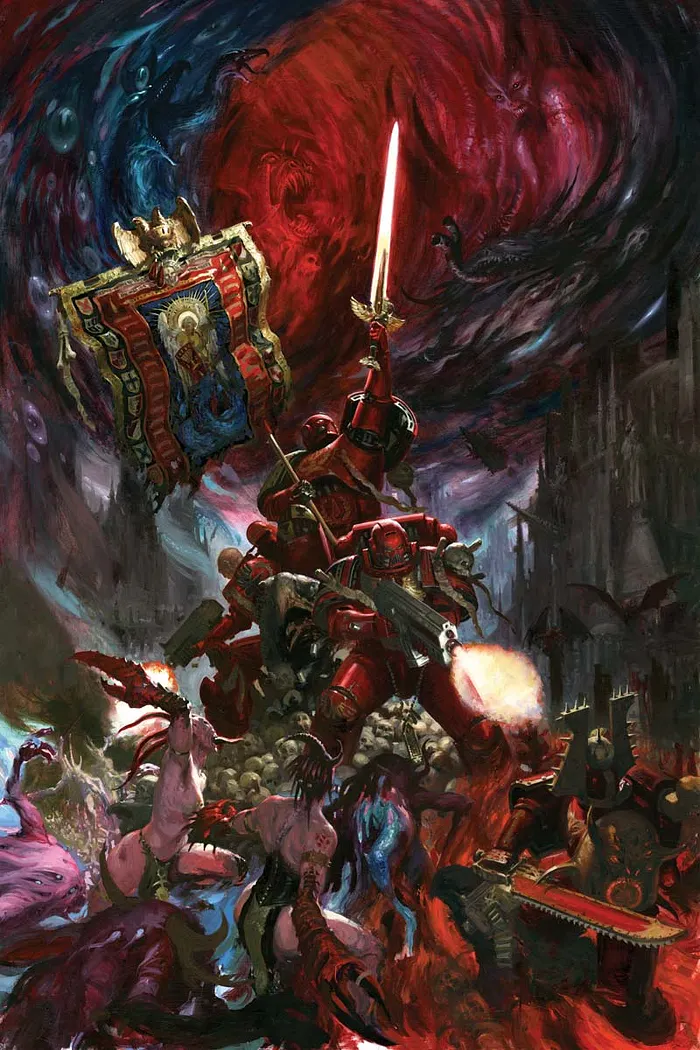
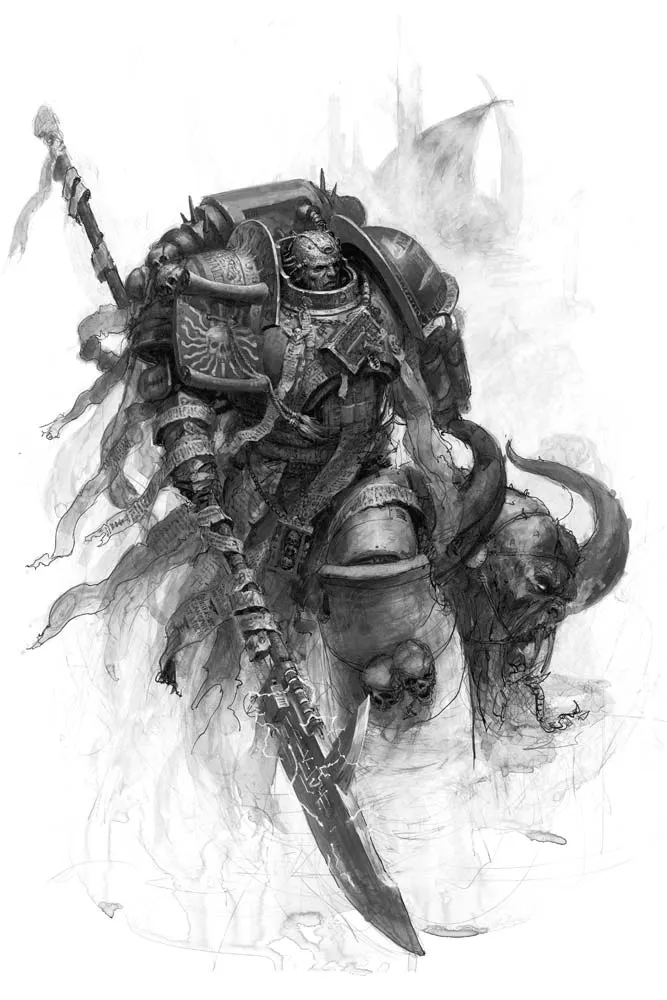
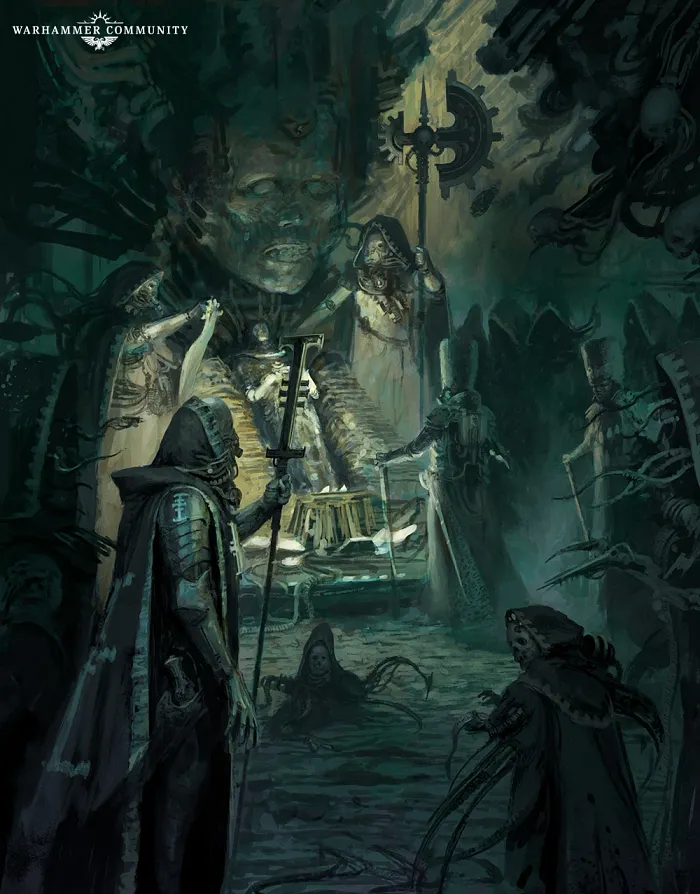
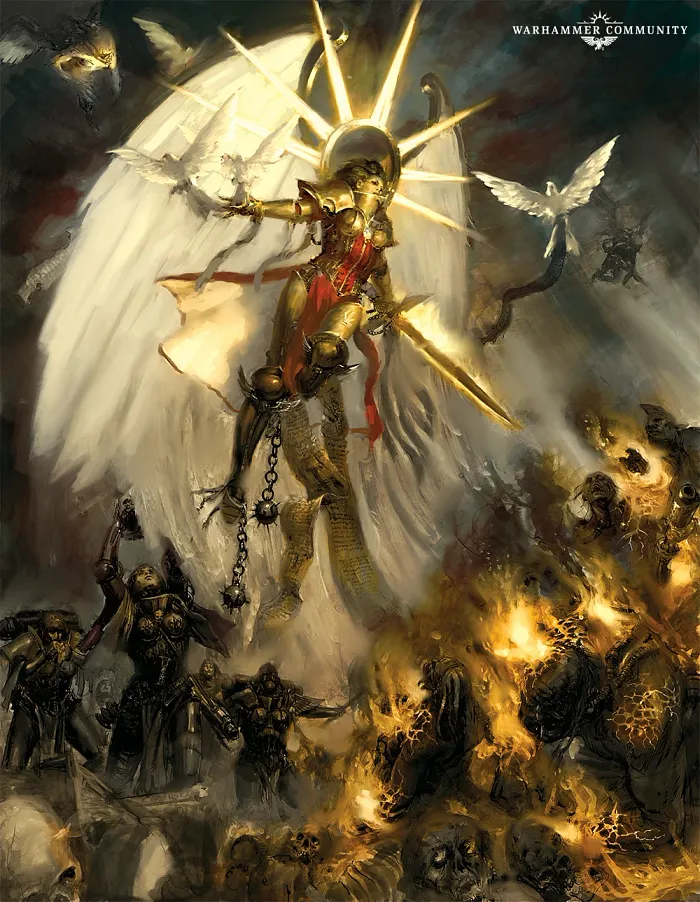
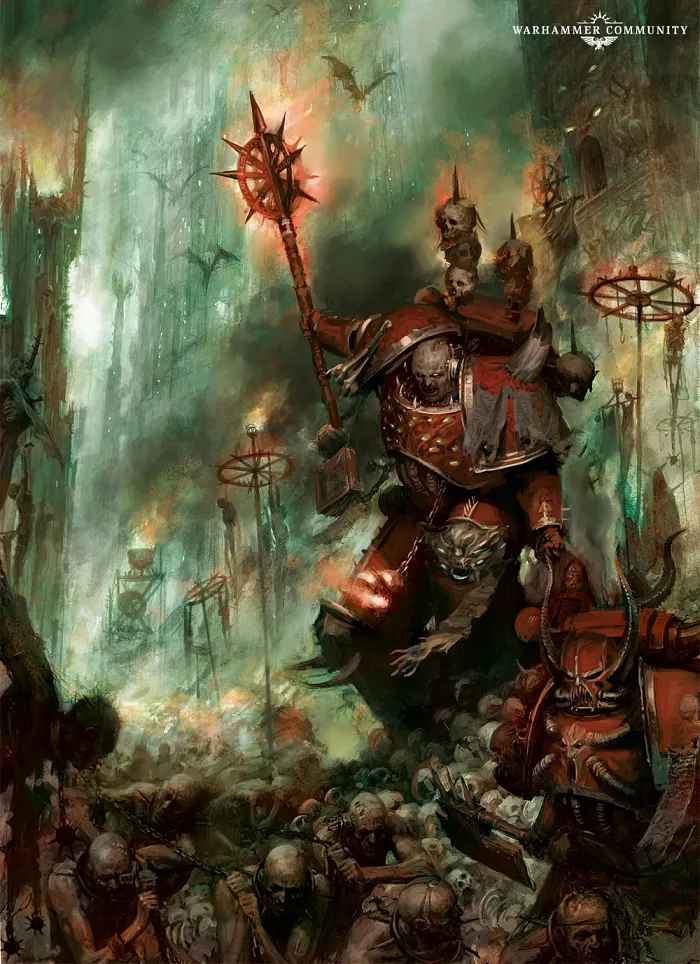
I have always thought of gnosticism as a kind of attractor within an attractor. We can’t help but be attracted to religion, to a universe that is deeply invested in us; a world so full of meaning that it’s painful, every wave of one’s hand bursting at the joints with metaphysical significance. And within that we can’t help but be attracted to a hatred of the world, a desire for it to fight back. You must strike through the mask. You have a divine spark in you yearning to be free, and the only way out is through. You must armour yourself in contempt and stare unflinching at the darkness to find salvation. Your God is there, burning with terrible beauty, and all he wants is for you to take up arms and defy the monsters that rule the material plane.
40k is a world where those gnostic instincts are simultaneously turned up to 11 and more literally true than you could ever imagine.
To this foundation add every cool fantastical element you can think of. Knights? Yes, and they have mech suits and giant guns and brotherly oaths and complicated systems of heraldry related to their genetic lineage. Zombies? Yes, and they’re Egyptian robots made of nanotechnology that use their own imprisoned pantheon as weapons. Hive-mind aliens? Yes, and they devour worlds so completely they leave sterilised rocks in their wake, while exuding a psychic miasma so oppressive it drives men insane.
Another aspect of 40k is that it can deliver on its promise of scale in a way few other cultural products can. All of these Biblical battles depicted in its artwork are engagements so unremarkable they don’t even merit mention in the overall narrative. There are thousands of years of history detailed in hundreds of books. Scores of stars and planets have names, histories, and distinct cultures. It backs up its aesthetic with decades of accrued content across every medium.
And the flagship way to engage with this is the tabletop game. This allows you to participate in the conflict directly in a way you can’t in, say, Lord of the Rings. It lets you claim a tiny slice of the universe. It asks a lot of you, as any meaningful activity does: there are the fantastically complicated rules to learn, hours to spend delicately painting each figure, the logistics of coordinating a match with another fanatic; and finally the matches themselves, which can absorb an entire afternoon.
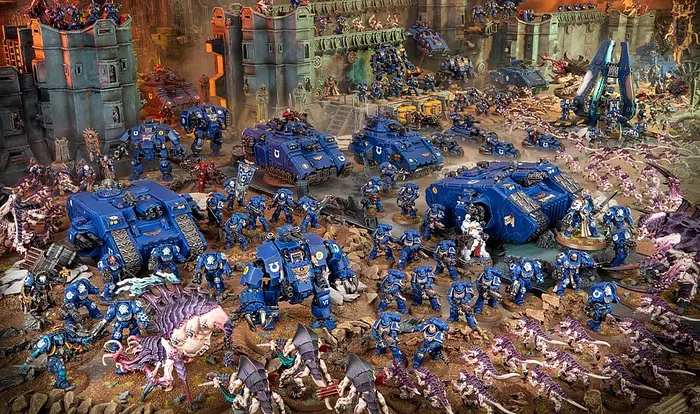
What is it about 40k that allows it to thrive culturally while being so unusual? The key is that it exists in a superposition of irony and seriousness. 40k is, officially, ‘satire’. You are not supposed to be a patriot for the Imperium of Man, a fascist theocracy. 40k media is constantly telling you how terrible it is to live in the Imperium while showing you how awesome the Imperium is. This property is unique because it was not chosen by any one person: 40k started as goofy British satire, like Discworld, but grew more serious in tone while retaining its basic elements. This trend was an iterative process that dozens of individual authors contributed to. Today, 40k’s canon is tended to by people who treat it with deadly seriousness, which is necessary for the whole thing to work.
40k enthusiasts buy into this seriousness. This isn’t to say that people don’t play with the elements of the setting, as in any fan community. But fundamentally they see an Imperial soldier being devoured by Tyranids as horrific, not comedic. This produces a tension between the world of the Imperium and modern liberal society. Some deliberately ignore this and treat 40k as pure entertainment. Some are uncomfortable, and try to reconcile their principles with the setting in various ways. Some buy in too fully and become real-life chuds. I try to balance the appeal of gnostic escapism while resisting its siren song. Realising why it’s appealing allows you to enjoy it without being consumed by it. 40k should be a way of enriching the world, not an excuse to abandon it. If you don’t accept the part of yourself that enjoys 40k, it’s hard to engage with it uncritically.
Warhammer 40k’s premise is ridiculous; it’s only by treating it with absolute, unrelenting earnestness that it comes alive. It was not until I left my adolescence that I realised this is also true about life.